
EAT THE RIBEYE. ORDER ANOTHER MARTINI. STAY OUT PAST MIDNIGHT.

And Get Back The Energy, The Sharp Mind, And The Bedroom Fire You Thought Were Gone For Good.
Here's the deal, and I'll say it right up front so you know what kind of letter this is.
You did not claw your way through forty years of work, raising kids, burying parents, and paying off everything you ever signed for — so that some 34-year-old in a white coat could tell you the fun is over.
The ribeye. The second martini. The dinner that starts at nine and runs till the waiter is stacking chairs. The weekend somebody suggests on a Thursday and you're in the car by Saturday morning.
That's not a problem to be "managed." That's the life. It's the reason you worked.
And somewhere along the way, somebody convinced you that keeping it was going to cost you your health — that the smart, responsible, grown-up thing to do now was to shrink. Smaller plate. Earlier night. Lower expectations. One more thing crossed off the list of things you used to love.
They had it backwards. You don't feel wrung-out because you're still living. You feel wrung-out because of one specific thing happening inside your cells — a thing that has a name, that science has watched happen, and that you can actually do something about.
What If Everything They Told You To Give Up After 50 Was The Wrong Answer?
Let's talk about the Quit List.
Nobody hands it to you on paper. It arrives in pieces. A comment from the doctor who's younger than your car. A headline you half-read. Your brother-in-law, who hasn't had a good time since the Carter administration, telling you what he "had to cut out" — like it's a badge.
And the list grows. Cut the red meat. Cut the salt. One drink, maybe, and only the red kind, and only with dinner, and honestly wouldn't you be better off with none? In bed by ten. Up at six. Walk, don't run. Sit, don't dance. Watch, don't do.

Every item gets sold to you as wisdom. As "being realistic about your age."
Here's what it actually is: a slow-motion agreement to stop being the person you've been your whole life. Somebody you never voted for decided your world should get smaller — and dressed it up as caring about you.
Now here's the part that ought to make you mad. You can do the whole list. Eat the sad salad, skip the nightcap, turn in early like a good patient for a solid year — and still drag yourself through every afternoon feeling like somebody let the air out of you.
Because the Quit List was never aimed at the thing that's actually draining you. It just made your life smaller and called that a cure. You handed over the steak and the late table and the fun, you paid every bit of the price they asked — and they never delivered the energy that was supposed to be waiting on the other side.
So let me ask you the question this whole letter turns on. What if the things they told you to give up were never what was draining you? What if you could keep the steak, keep the drink, keep the late table — and feel better than you do right now eating like a monk?
That's not a fantasy. There's a reason it's possible — and before this letter's done, you'll know exactly what it is.
The Cruelest Part Of Getting Older Isn't What You Can't Do. It's What You Stop Even Trying To Do.
Think about the last time you turned down something you used to say yes to without blinking.
The friend who floated a spontaneous weekend away — and you heard yourself say "ahh, maybe next time," because some quiet voice did the math and decided you'd be too wiped out to enjoy it. You didn't decide you couldn't go. You decided it wasn't worth how you'd feel the next day.
The couple who used to shut down the dance floor and now books the 5:45 reservation, home by eight, shoes off by eight-fifteen. Nobody announced a thing. The world just got a little smaller, one early night at a time.
That's the part that gets people. Not the dramatic stuff. The quiet subtractions.
And here's who clocks it first — before you do. The person you married. They've watched you go quiet these last few years. Watched you wave off the trip, pick the early table, nod off in the chair before the show's half over. They haven't made a thing of it. But they've seen the lights going out one at a time, and some nights they miss the person who used to be sitting across from them.
You don't wake up one morning and declare you've given up. It's slower and sneakier than that. It's a hundred tiny "nah, not tonights" that nobody notices — least of all you — until you look up one day and realize the circle you live in has shrunk to the size of your couch and your routine, and you can't remember the last time you did something that surprised you.
Nobody surrenders on purpose. They just keep saying "maybe next time" until there aren't many next times left.
There is something to be done about it. And it's not on any list your doctor ever handed you.
Why Does A Good Night Out Now Cost You The Entire Next Day?
Let's get concrete, because this is the one everybody recognizes.
It's not even a wild night. It's a normal one. Dinner with friends, a couple of drinks, good conversation, home at a reasonable hour by the standards of a person who's lived a little.
Then comes the morning.
You open your eyes and the first thing you do is find the clock. Nine-forty. Later than you meant. And before your feet even hit the floor you can feel it — the day already has a lead on you, and you are not going to catch it. Head full of wet sand. The good light of the morning is burning off out the window, and you're going to spend it just getting vertical.

One cup of coffee, then another, then a third you don't even enjoy. The to-do list sits there and sneers at you. You get the one errand done and call it a victory. By four in the afternoon you're eyeing the couch like it's calling your name in a voice only you can hear. One good evening, and it cost you a whole day. That's the trade you've quietly started making — and it's the real reason you keep turning the evenings down.
Now here's the word this whole thing turns on. It isn't "energy." Everybody wants more energy; that's a bumper sticker. The word is resilience.
Resilience is the thing you used to have and never once thought about — where a good evening was just a good evening, and the next morning you got up and went about your life. Where a full day didn't have to be paid for with the day after it. Where you could have the dinner and the conversation and the late table, and still wake up with something left in the tank for tomorrow.
That's the real thing you've lost. Not the ability to have one big night — anybody can white-knuckle one big night. What's gone is the bounce-back. The margin. The quiet confidence that you can spend yourself on a life worth living and refill overnight the way you always did.
And that bounce-back isn't about willpower, and it isn't about how "clean" you ate. It runs on something physical happening inside every cell in your body — something that used to hum along without you ever giving it a thought, and has been quietly winding down for years.
The Most Expensive Thing You've Lost Isn't Money. It's Your Get-Up-And-Go.
Picture the man or woman who did everything right.
Worked the long years. Saved. Paid it down. Finally arrived at the part they'd been promising themselves since they were thirty — the time, the money, the freedom. Nobody's boss anymore. The calendar is theirs. The whole point of the grind, cashed in and sitting right there for the taking.
And they're too tired to take it.

Sit with that one, because it's the cruelest arithmetic there is. You can spend your whole life building the freedom to do anything — and arrive at it without the energy to do much of it. That is not a small irony. That is your life's work — the entire forty-year climb — and the view from the top is a nap.
The trip you can finally afford, and you're dreading the airport. The grandkids you waited your whole life to spoil, and an afternoon with them leaves you flattened for two days. The partner across the table — the one who's been quietly watching you fade — and by the time the dishes are done you've got nothing left to give them but the back of your head on the pillow.
And now the part nobody wants to say out loud. This doesn't hold still. Where you are right now is not where you stay — it's a slope, and it only tips one way. The shortage that's making this year harder than last year is still draining, by the month, whether you do a single thing about it or not. Next year the airport is worse. The afternoon with the grandkids costs three days instead of two. The window you've been saving the good life for is open right now — and it is closing. And the cruelest version of this whole story is the one where the money's still sitting in the account and the years you meant to spend it on have quietly gone by.
Money you can always make more of. You proved that already — it's the one thing you're sure you can do. Energy is the currency you can't earn back by working harder. And it's the only one that actually buys the life you worked for.
So the real question was never "how do I protect my health by giving things up." The real question is: how do I get the energy back to use the life I already built — while I've still got the years to spend it?
And the reason you feel this way isn't willpower. It isn't "just your age." And it isn't one single thing on the Quit List.
It Was Never Five Problems. It Was Always One — And It Has A Name.
Here it is. The one thing. And I mean one.
Everything we just spent six pages on — the morning you can't climb out from under, the afternoon that folds at four, the trips you wave off, the circle shrinking to the size of your couch — is not a dozen separate things going wrong at once, the way they've had you believing. It is one thing. One shortage. Happening in the same place, for the same reason, in nearly every cell you've got.
Science has watched it happen. It can measure it. It can put a name to it. And here's the part that ought to put you right up on the edge of your chair: it is fixable. Not "manageable." Not "something we can slow down if you give up three more things you love." Fixable — because it's a shortage of one specific ingredient, and a shortage of something is the most fixable problem there is. You put the thing back.
Let me show you exactly what it is.
Inside nearly every cell you've got are tiny engines called mitochondria. They turn your food and your breath into the raw energy that runs the whole show — your legs, your heart, your head, your drive, all of it. When those engines are firing, you feel like yourself. When they sputter, you feel like a flashlight with a dying battery, no matter how much you sleep or how clean you eat.
Those engines run on a molecule called NAD+.
Think of NAD+ as the spark that keeps the engine turning over. And here's the part that'll make you sit up: at 25, your NAD+ is running at basically full. By 40, you've lost around a quarter of it. By 60, you're running at about half.
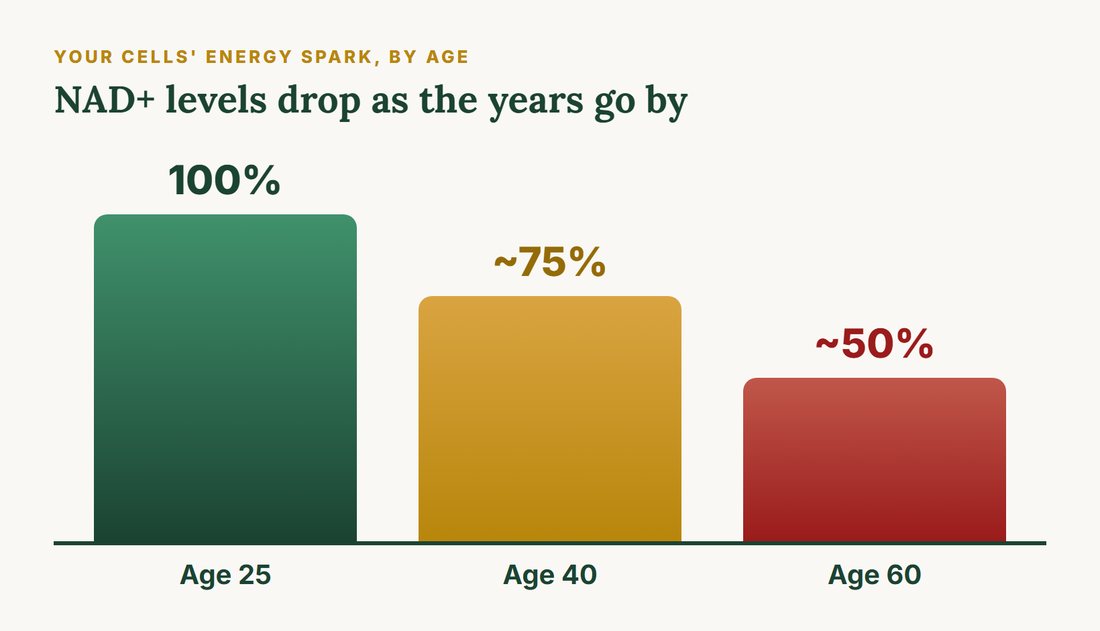
Half the spark. Same engine. That is not a character flaw, it is not laziness, and it is not "you letting yourself go." It is a measurable shortage of one specific ingredient — and it has been draining out of you by the year, quietly, the whole time you were busy blaming yourself.
I'm not going to hedge this, because the science doesn't hedge: when the spark runs low, the engine runs low, and you feel exactly the way you've been feeling. The afternoon that flattens you. The morning you can't climb out from under. The bounce-back that won't bounce. A lot of what you've been chalking up to "just getting older" isn't five separate problems — it's one engine, running low on one spark.
Now, I'm going to be careful with you here, because you can smell a huckster. I am not going to stand at this bar and tell you one molecule explains every single thing that's ever gone sideways in your body — that's the kind of promise that should make you keep a hand on your wallet. But your energy? Your stamina? Your ability to put in a full day and still have something left for tomorrow? That runs on this. And that you can do something about.
So here's the obvious question. If NAD+ is the thing that runs low, why not just swallow some NAD+ and top it off?
So Here's The Answer. And It Comes In A Bottle.
Here's what the outfits selling jars of straight NAD+ won't tell you: your cells won't let it in. The NAD+ molecule is too big to cross the cell wall. Swallow it and most of it never reaches the engines that need it. For years that was the dead end — everybody in the field knew NAD+ was the answer, and nobody could get it where it had to go.
Then they found the back door. Your body already knows how to build its own NAD+ out of a smaller building block — a precursor called NMN. NMN is small enough to slip right through the cell wall, and once it's inside, your body converts it straight into NAD+. You're not forcing a foreign molecule where it doesn't belong. You're handing your own cells the exact raw material they've been starving for, and letting them do the thing they already know how to do.
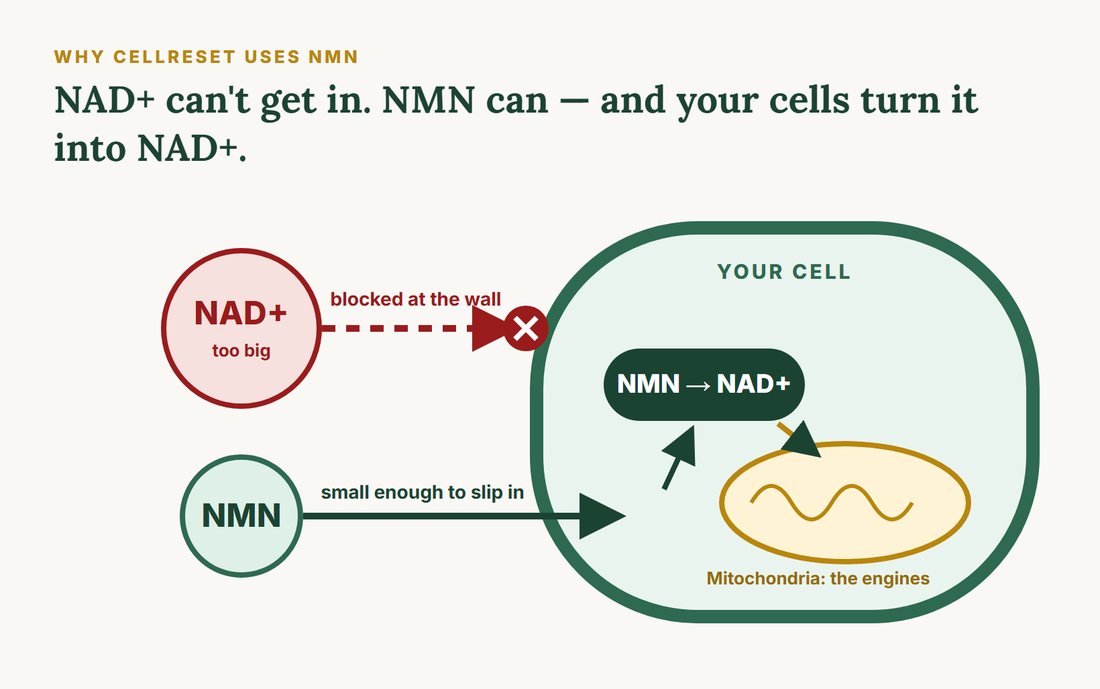
Feed the cells NMN. The cells make NAD+. The engines get their spark back. That's the whole game — and it's the piece the Quit List never had, because there is no amount of salad or early bedtimes that makes you more NMN.
So that's the how. Here's the what.
It's called CellReset. Two capsules. Once a day. Five hundred milligrams of pure NMN — the full clinical dose, the exact amount the human research is built on — in two capsules you take with your morning coffee or your evening ribeye, and then don't think about again until tomorrow.
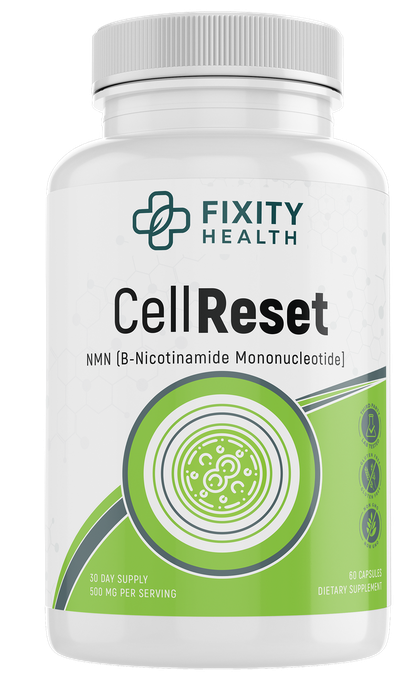
That's the entire protocol. No powders to mix. No fistful of pills lined up on the counter. No chart on the fridge. The thing science spent a decade chasing — a way to get the spark back into cells that had been running low for years — turns out to fit in the palm of your hand and take about four seconds a day.
This is what the whole letter has been walking toward. Not a biology lesson. A bottle on your counter that hands your cells the one thing they've been missing. The resilience you've been grieving — the bounce-back, the full day with something left for tomorrow, the morning you climb out from under instead of lying there doing the math — doesn't live in a research paper. It lives in those capsules, and in what your own body does with them starting the morning you take your first serving.
And because you've earned the right to be skeptical of anything you're asked to swallow, here's exactly what you're holding when you hold a bottle of CellReset.
Five hundred milligrams of pure NMN — the full clinical dose. Not a token sprinkle so a label can print the word on the front and hope you never turn the bottle over. This is the actual amount the human research was built on. When the studies you're about to read got their results, this is the dose that got them. We put in what the science says works, at the number the science says it works at, because anything less is just an expensive way to take nothing.
Third-party tested — every single batch. Purity, potency, heavy metals, the whole workup — checked by an outside laboratory that does not draw a paycheck from us and has not one reason on this earth to be kind. We don't get to grade our own homework. Somebody with no skin in the game signs off on every run before a single bottle is allowed anywhere near your counter.
Made right here in the United States, in a state-of-the-art, FDA-registered facility that runs to GMP pharmaceutical standards. Non-GMO. Gluten-free. The kind of clean room, controlled process, and paper trail that a great deal of what gets sold in a bottle these days has never once stood inside of. This is a serious product, built by serious people, to a standard they'd be proud to hand their own families — because that is exactly the bar they hold it to.
That's the bottle. One ingredient, the right amount of it, nothing hiding behind a vague "proprietary blend," made clean and proven clean by people with everything to lose if it isn't. It's the difference between swallowing a mystery every morning and reaching for something you actually trust.
This Isn't A Hunch. It's Harvard.
Here's the proof — and the drinks, the late night, and the morning you still feel like yourself.
I don't expect you to take a stranger's word on any of this. You've been around too long to buy the first thing somebody slides across the bar. So let's not rush it. Let's walk through the proof one piece at a time, slow, and watch it stack — because by the time we're done, I don't think you're going to have a lot of room left to doubt it.
Start with the study that lit the whole fuse. 2013. Dr. David Sinclair's lab at Harvard. Published in Cell — not a newsletter, not a podcast, one of the most respected journals there is. They took old mice — the mouse equivalent of senior citizens, stiff and slow and winding down — restored the NAD+ in their cells, and then they watched.
In eight days, the muscle, the mitochondria, and the coordination of those old animals came back to match six-month-old mice. Young mice. Let that sit for a second, because it's the whole promise of this letter in one experiment: an old engine running low isn't a broken engine. It isn't used up. Put the spark back, and it runs young again. And "runs young again" isn't a line on a lab report — it's the morning you swing your feet out of bed without the wet sand in your head.
"Mice," you're thinking. Good. Stay skeptical. So the next question is the right one: does the building block even get into a human being and go to work? Dr. Shin-ichiro Imai's team at Washington University put that one to bed. NMN is absorbed and moving within about thirty minutes of swallowing it. It doesn't sit in your gut waiting for permission. It's up, it's in the bloodstream, it's on its way to your cells before you've finished the breakfast dishes. This isn't a someday-maybe. It's a this-morning.
Now the one that ought to matter most to you and me — because this time it wasn't mice, and it wasn't thirty-year-olds. 2021. Keio University. A placebo-controlled trial — the real kind, where nobody gets to fool themselves — in men sixty-five and older. People your age. People with the same miles on them you've got. After twelve weeks, the group taking NMN showed better muscle performance and faster walking speed than the group taking nothing. Read that in plain English: more in the legs. A body that keeps pace with the day instead of begging off it halfway through.

And if the back of your mind just asked, "fine — but is it safe at the dose I'd actually be taking?" — that one got answered first, all the way back in 2016, in the first human safety trial. They ran people right up to 500 milligrams — the exact dose in a serving of CellReset — with no serious adverse effects. So there it is, both halves nailed down: safe at the dose, and it moves the needle in bodies that have been around as long as yours.
One more, so you know this isn't some fringe thing ducking the authorities. In 2023, the FDA's position on NMN as a legitimate dietary supplement was clarified. This isn't contraband off the back of a card table. It is one of the most-studied longevity molecules on the planet — and it's sitting one decision away from your front door.
Here's a doctor you may know from the bestseller shelf, putting it plainer than I can. Dr. Mark Hyman, Director of the Cleveland Clinic Center for Functional Medicine:
"Restoring NAD+ is not biohacker fringe. It is one of the cleanest cellular interventions we have for the decline most of my patients over 60 are describing. I recommend NMN to my own family members." — Dr. Mark Hyman, Director of the Cleveland Clinic Center for Functional Medicine
When a doctor of his standing says he gives it to his own family, that's not a man selling a supplement. That's a man reading the same research you just read.
But the studies aren't what made me want to put this in your hands. It's the regular people. Four of them, in their own words:
"I mowed the whole yard on a Saturday without the recliner nap after. I'm not saying I'm 30 again. I'm saying I'm me again. There's a difference, and it matters." — Dale Winters, 68, retired sheriff's deputy
"I feel more myself at 72 than I did at 65. The body is back under me. I didn't know how much of what I thought was mourning was actually empty fuel tanks." — Barbara Whitman, 72, retired ICU nurse
"First time in eight years I've woken up actually rested." — Walt Piasecki, 66, Nebraska farmer
"I felt 85. I feel 60 now." — Ruth Calderon, 74, retired bilingual elementary teacher
Four different lives. One and the same thing underneath all of it: the spark came back on.
Before We Talk Price, Let's Be Clear About What You're Actually Buying.
Because it isn't a bottle of capsules. Nobody ever wanted a bottle of capsules.
What's on the table is the great dinner and the second drink that goes with it — and waking up the next day with something still in the tank, the way you used to for years without ever once thinking about it. It's opening your eyes and wanting the day, instead of lying there doing the math on whether you've got enough to face it. It's the weekend somebody floats on a Thursday, and you're in the car Saturday — because "I'll be too wiped out" finally stopped being the first thing out of your mouth.
It's having something left for the person beside you when the night isn't over yet. And yes — let's say the quiet part out loud, because you're far too old to blush at it — the want comes back too. Not "maybe this weekend, if I'm not wiped out." Tonight. The spark that used to just be there, the one that turned an ordinary Tuesday evening into something neither of you planned on — back. Reaching for the person next to you because you flat-out want to, instead of rolling over, clicking off the lamp, and telling yourself there's always some other night. There doesn't have to be some other night. There's this one. That's on the table here too, and you're too old to pretend it isn't.
That's the real purchase. The capsules are just how it gets delivered.
Now — what's something like that worth? Start with what the problem has been costing you. A month of wrecked days, every good morning burned off before you're even vertical. The runaround — the appointments, the co-pays, the specialist who shrugs and says it's your age. The drawer full of half-finished supplement bottles you bought on a hunch and quit by week two. Stack one month of that up and it's already more money, and a lot more disappointment, than anything I'm about to ask you for.
A real longevity protocol — the full clinical dose of the one molecule all that research is built on, tested clean, delivered to your door, with a shelf of guides stacked on top — is the kind of thing you'd expect to run a hundred and fifty, two hundred dollars a month. And at that number it'd still be a fair trade for your get-up-and-go.
It isn't that number.
A bottle of CellReset is a full month — 60 capsules, two a day, the complete 500mg clinical dose. And you've got two ways to get it.
Thirty-nine dollars a month.
That's it. Less than you'd leave on the table after the dinner we were just talking about. The full clinical dose, the tested-clean bottle, the whole thing science chased for a decade — for about a buck-thirty a day.
Put thirty-nine dollars next to a morning the day doesn't already have a lead on you. Next to an afternoon that doesn't fold on you at four. Next to a Saturday you're in the middle of instead of watching from the chair. Next to being, on an ordinary Tuesday, somebody your husband or your wife looks at twice. It stops being a price the second you say it out loud.
And saying yes is built to be easy. Start on Home Delivery and a fresh bottle shows up at your door every month on its own — you don't reorder, you don't set a reminder, you don't open the cabinet one morning to find you ran out three days ago and the spark's already slipping. Shipping's free. Your $39 is locked for life — whatever happens to the price down the road, and NMN is not getting cheaper to make, yours is frozen the day you start. Cancel anytime, no song and dance, no "let me transfer you to retention."
Or if you'd rather just test the water first: one bottle, $49, plus $9.95 shipping. No deliveries, no commitment. A bottle on your doorstep so you can find out for yourself.
And You Risk Absolutely Nothing. The 60-Day Empty-Bottle Guarantee.
I'm not going to ask you to gamble on this. So I'm taking the gamble off the table entirely.
Order CellReset and take it. Give it a real 60 days — two full months to see what it does in your own body, on your own schedule, with your own money sitting safe on the sidelines the entire time. This isn't some seven-day trial that's over before anything's had a chance to happen. It's two months to make up your mind, with nothing at risk but the half-minute a day it takes to swallow two capsules.
And if, at the end of it, you're not satisfied — for any reason, or for no reason you feel like explaining to anyone — you send the bottle back. Full, half-empty, or scraped down to the last capsule. Doesn't matter. You get every dollar back.
No form to fill out. No survey. No person on the phone trying to talk you out of it or make you feel small for asking. You say the word, you get your money. Done.
Read that again, because it's the whole ballgame: I'm telling you to use the bottle and still get a full refund if you decide it wasn't for you. You carry none of the risk here. The only thing you're agreeing to is to find out.
And Because You're Starting Today, I'm Throwing In Three Things.
I wanted the people starting now to have more than just the bottle in hand. So I'm including three guides, free, emailed to you within minutes of checkout:
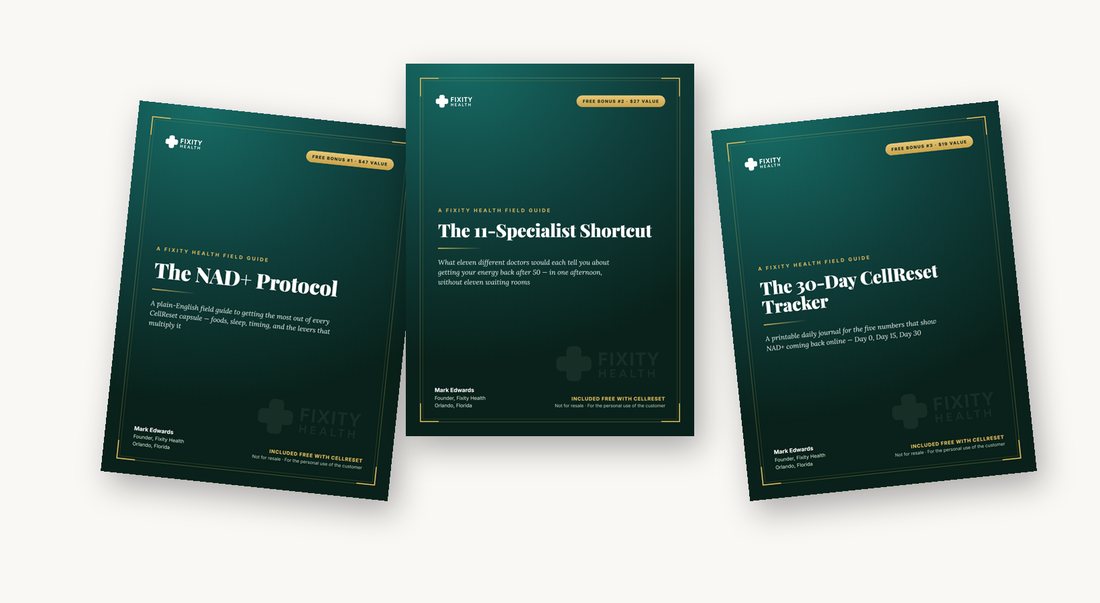
The NAD+ Protocol — a 47-page field guide to getting the most out of rising NAD+: how to squeeze every bit of NMN into your cells, and the small daily moves that stack on top of CellReset so the spark climbs faster and holds longer. (Sells on its own for $47.)
The 11-Specialist Shortcut — a plain-language self-assessment that walks you through the eleven most common "age-related" complaints and shows you where they trace back to the same engine, so you can stop dragging yourself through eleven different waiting rooms for eleven "separate" problems. ($27.)
The 30-Day CellReset Tracker — a printable daily journal built around the exact things to watch, so you can see the change happen with your own eyes instead of guessing at it. The energy, the sleep, the mornings — written down, plain as day by week three. ($19.)
Ninety-three dollars of guides, yours the moment you start. And they're yours to keep for good — even if you use the guarantee and send the bottle back.
You've Got A Decision To Make, And The Clock Is Already Running.
Not my clock. Yours.
Remember the number from earlier — about half your NAD+ gone by 60, and still sliding. That's not a sales gimmick I can switch on and off. It's happening whether you order or not. Every month you spend "thinking about it" is another month your cells run the ingredient a little lower, and another month of mornings you don't get back.
The Home Delivery price-lock won't sit around waiting, either. Thirty-nine a month, frozen for life, is for the people who start now. I can't promise that number stays untouched while NMN gets more expensive to make.
So here's the whole thing in one breath. You can keep doing what you're doing — keep saying "maybe next time," keep eyeing the couch at four, keep trusting the lie that this is just what your age feels like. Or you can hand your cells the one ingredient they've been missing, take it every day for two months on my dime, and find out what the other version of the next ten years feels like.
Picture the night a year from now. You're the last table in the place again — not because you're clinging to anything, but because you've simply got gas in the tank and nobody's ready to go home yet. You eat what you want. You order the second drink. You close the place down, and tomorrow you get up and go about your life, the way you used to, back when it never once crossed your mind you'd ever have to think about it.
But that's not the real payoff. And I think, somewhere, you already know it.
The real one is sitting across the table from you. The person you married. The one who's spent these last few years quietly watching you fade — picking the early reservation, waving off the trip, going a little more silent each season. Tonight they look across the candlelight at you, and for the first time in a long while, they're not looking at who you've been turning into. They're looking at who you've always been. They see the one they married sitting right there.

That's the thing worth more than another martini. That's what's actually on the table here.
You didn't earn a smaller life. Don't let anybody talk you into one. Keep the ribeye. Keep the martini. Keep the late table. And take back the fuel to enjoy every bit of it — and to be, once again, the person the one sitting beside you has been missing.
Your cells are ready to get back to work. All they've been waiting on is the one ingredient only you can hand them.
Start today.


Mark Edwards
Founder, Fixity Health
Orlando, Florida
P.S. — Let's keep it simple. CellReset is 500mg of pure NMN — the building block your body turns into NAD+, the spark your cells run low on with age and the real reason a good night now costs you the whole next day. Start on Home Delivery and you lock $39 a month for life, free shipping, cancel anytime; or grab one bottle for $49 plus $9.95 shipping. Either way, you take it for 60 days, and if you're not satisfied you send the bottle back — empty, if that's how it goes — and get every dollar returned, no questions, no form. Keep the three guides regardless. The one thing you can't send back for a refund is the year you spend deciding. Start today.