
The Single Molecule Your Body Stops Making at 40 — And Why Every "Age-Related Disease" Is Really One Disease In An Eleven-Specialist Costume
Harvard Medical School restored this molecule in aging mice in 2013. In 8 days, their muscle, energy, and coordination matched 6-month-old animals. Measurable. On video. And then the medical mainstream walked past the paper like it was a weather report.

Dear Friend,
I see you.
I see you at 3 p.m. yesterday, hand on the kitchen counter, waiting out the wave of tiredness that wasn't there six years ago. Eight hours of sleep the night before. A good breakfast. And still — the wave.
I see you last Saturday at your granddaughter's soccer game, sitting on that aluminum bleacher, watching the other grandparents pace the sideline — and feeling in your hips and your knees that you used to be the one pacing. You cheered. You smiled at her when she looked up. You wondered, quietly, how many more of these games your body was going to let you show up for.
I see you in front of the bathroom mirror, running your thumb across the skin on the back of your other hand. The skin that used to bounce back. The skin that now folds, a half-second slower, before it remembers what it's supposed to do.
I see you digging through the nightstand drawer for the old photo — 2015, on the boat, the year you caught the redfish — and you hold that photo next to your face in the mirror and you feel something you can't quite name. Not sad exactly. Not afraid. Something older than both. Something like: who is the man that replaced the man in this picture, and when did he move in?
I see you lying awake at 3:47 a.m., staring at the ceiling fan, doing the math on your father's age when he died. Your mother's age when she stopped being able to drive. The arithmetic every American over 60 does in the dark and never speaks out loud.
That's the sentence, isn't it. That's the one underneath all of it. Not the tiredness. Not the stiffness. Not the photo. That one sentence — whispered to the ceiling at 3:47 a.m. — is the real reason you opened this page.
I'm not going to lie to you. I'm not going to promise you twenty years back. I'm not going to pretend the last fifteen years of American healthcare haven't been a slow-motion betrayal of people exactly like you.
I'm just going to tell you the truth. And the truth has a number on it: 2013.
The One Belief That Changes Everything
Here is what I want you to hold in your hand for the rest of this letter. Read it once. Then read it again, slower.
That's the whole letter in one sentence. Everything else is proof.
The molecule is called NAD+ (nicotinamide adenine dinucleotide, but you don't have to remember that). It lives in every single one of your 37 trillion cells. It runs your mitochondria — the microscopic power plants that make the energy your body uses to do every single thing it does. Walk. Think. Heal a cut. Sleep. Remember a name.
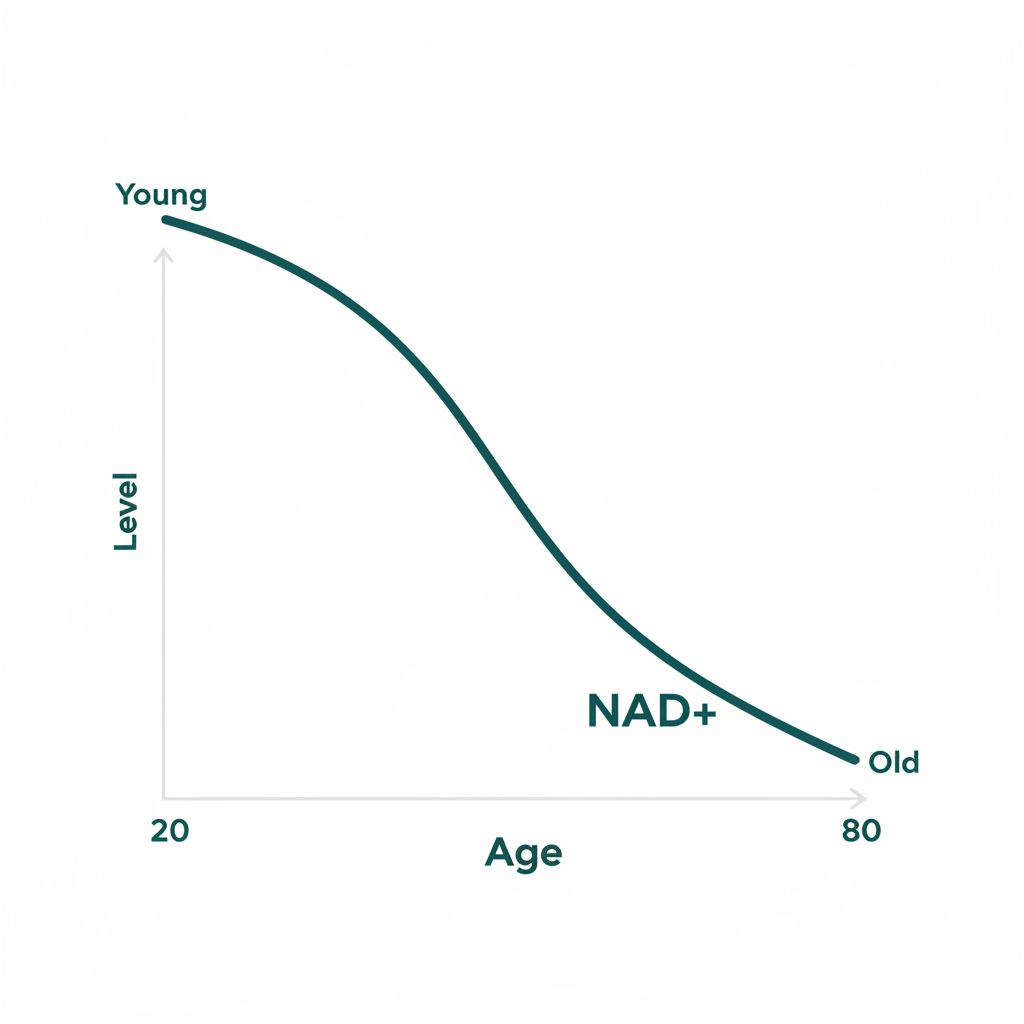
At 25, your NAD+ levels are at 100%. That's why 25-year-olds recover from a hard weekend in four hours and run up a flight of stairs without thinking about it.
By 40, your NAD+ has dropped about 25%.
By 60, it's at roughly 50% of what you had at 25.
By 80, it's down to 10-15%.
And here's the part that will make the air leave the room for a second: every single thing the medical system calls "age-related" — the muscle loss, the blood sugar drift, the thin skin, the 3 p.m. crash, the memory slips, the slow healing, the bad sleep, the joint pain, the libido drop, the weakening eyes — all of it is downstream of that one shortage.
Your cardiologist doesn't know that. Your endocrinologist doesn't know that. Your dermatologist doesn't know that. Because each of them was trained to stare at the branch of the tree they were assigned to. Nobody was trained to look at the trunk.
Harvard looked at the trunk in 2013. I'll tell you that whole story in a minute.
Let Me Talk To You Like A Friend Across A Diner Booth

Before I get to the science, let me shift gears and talk to you the way I'd talk to a buddy who just sat down across from me in a booth at the diner with two black coffees between us.
The American medical model — the one my father trusted, the one your father probably trusted, the one you're still trusting because nobody's shown you an alternative — is a shell game. And the shell it's playing with is your body.
Here's how the shell game runs. You turn 60. Something starts drifting. The numbers on your blood work creep. You go to your primary care doctor. He doesn't have time to think — 14 minutes per patient, 2,400 patients on his panel, a computer screen he's been charting against the whole visit — so he hands you off. Blood sugar? See the endocrinologist. Memory? See the neurologist. Heart? Cardiologist. Skin? Dermatologist. Bladder? Urologist. Sleep? Sleep specialist. Mood? Psychiatrist. Bones? Rheumatologist. Hearing? ENT. Eyes? Ophthalmologist. Plumbing? Urologist again, this time with a different list of questions.
Eleven specialists. Eleven waiting rooms. Eleven co-pays. Eleven prescriptions. Eleven "follow up in 90 days."
Not one of those eleven doctors ever talks to the other ten. Not one of them ever asks the question a sixth-grader would ask on the first day: "Wait — if every single system in this man's body is breaking down at the same time, in the same decade, doesn't that suggest there's one thing going wrong that all of these are a symptom of?"
Nobody asks. Because asking isn't billable. Asking doesn't generate a CPT code. Asking doesn't sell a drug.
Meanwhile the American anti-aging pharmaceutical and cosmetic industry is now a $50 billion a year business — and almost every dollar of it is aimed at branches of the tree. HRT for the hormones. Ozempic for the sugar. Statins for the cholesterol. Viagra for the plumbing. Aricept for the memory. Ambien for the sleep. Tretinoin for the face. Eleven products for eleven branches of one tree nobody's looking at.
And right now, sitting in the dirt underneath that tree, is a molecule — documented in 800+ peer-reviewed papers, endorsed by physicians at Harvard, Washington University, and the Cleveland Clinic, granted legitimate dietary supplement status by the FDA in 2023 — that rebuilds the one thing the tree was missing.
They don't want you to know. So I'm telling you.
Why I Wrote This Letter — And Why It's Different From The First Two
Before we go any further, you should know who I am and where this product came from. Not the polished bio. The real one.
My name is Mark Edwards. I built FixityHealth.com. And if you've gotten a letter from me before about NatureZemp — our berberine formula for blood sugar — or Mind Forge 10x — our ten-mushroom cognitive stack — you already know part of this story. You know my father's name was Tom Edwards. You know he was a plumber, a Navy veteran, a man whose laugh you could hear from the other end of the house. You know he died at 71 on eleven prescriptions.
What you may not know is that the first two products I built — NatureZemp for Tom's diabetes, Mind Forge for Tom's dementia — were only ever going to be half the answer. They treated the two branches of the tree that broke off first. They helped. They helped a lot. But they weren't the whole truth. And I knew it.
I buried my father at 71. Here is what was on his diagnosis list at the end:
Type 2 diabetes. Vascular dementia. Sarcopenia — they had a separate name for the muscle loss that had taken his forearms down from plumber-hands to something that shook when he lifted a coffee cup. Macular degeneration — the gray smudge that started in his left eye in 2017 and slowly ate his reading. Osteoporosis — the compression fracture in his lower back from bending wrong to pick up the cat. Chronic fatigue he couldn't sleep off. Sleep apnea — the CPAP machine that hissed next to the bed every night. Erectile dysfunction, because at some point the little blue pill stopped working too. Hearing loss they called "presbycusis" and handed him a $5,000 pair of devices he never wore. Slow-healing skin infections from a paper cut that took seven weeks. And a slow-creeping kidney decline his nephrologist was "watching."
Eleven separate diagnoses. Eleven prescriptions in the plastic pill sorter on the kitchen counter by his recliner.
I remember the sorter. Seven little compartments in a row — S, M, T, W, T, F, S — and each compartment so full Mom had to use the eraser end of a pencil to tamp the pills down every Sunday night. A seven-compartment box. Eleven pills per compartment. I watched her do it the October before he died, her hands shaking a little, and I remember thinking: this is not medicine. This is a diorama of a man being dismantled.
After we launched NatureZemp for the blood sugar side, and Mind Forge for the memory side, I could not sleep. I was glad for the customers who were getting their numbers back. I was glad for the Dorothys and the Walters and the Bills. But I kept looking at the other nine things on my father's diagnosis list and asking: why did all of it come apart at once?
I spent six months on PubMed. Two a.m. every night. Coffee going cold at my elbow. My wife bringing me a blanket at 4. And somewhere around month four, I found a 2013 paper out of Harvard Medical School that stopped my breath.
Dad wasn't failing in eleven ways. He was failing in one way that looked like eleven. The cells had quit running the factories. And every factory — every organ, every system, every function — had started shutting down independently because the one thing they all needed had run dry.
That's the discovery that built CellReset. If I'd known about it in 2015, before the cascade got ahead of us, I believe with my whole heart my father would still be here. He would be 79 this year. He would be at my daughter's graduation in June.
He isn't. But you still can be. That's why I wrote this letter.
The 2013 Harvard Paper That Should Have Been On Every Front Page

The paper is titled — and I will give you the real title because I want you to be able to look this up yourself — "Declining NAD+ induces a pseudohypoxic state disrupting nuclear-mitochondrial communication during aging." Published in Cell, one of the three most prestigious journals in all of biology. Lead researcher: Dr. David Sinclair, professor in the Department of Genetics at Harvard Medical School.
Here's what they did. They took a group of mice that were 22 months old — which, in mouse years, is roughly 70 in human years. Gray around the muzzle. Slower on the wheel. Losing muscle. Losing coordination. The mouse version of your neighbor after his third knee replacement.
They measured the mice's NAD+ levels. Way down. Same pattern as aging humans.
Then they gave the mice a precursor molecule — something the body converts into NAD+ — and they measured again.
Within eight days, the NAD+ levels in those old mice matched the levels of 6-month-old mice. But here's the part that should have been on the front page of every newspaper in America:
- Their muscle tissue regenerated. Biopsy samples of muscle from the treated old mice were physically indistinguishable from the muscle of young mice.
- Their mitochondrial function — the cellular power plants I mentioned — came back online. Energy production in the cells of 22-month-old mice matched that of 6-month-old mice.
- Their insulin sensitivity normalized. The metabolic markers that had been drifting toward diabetes corrected.
- Their coordination returned. The Harvard team filmed it. You can still find the footage. Old mice walking steadier. Grip strength back.
Eight days. In a peer-reviewed, published, replicated experiment, at Harvard Medical School. Not a fringe lab. Not a wellness blog. Harvard.
The paper was published. The replication studies followed. The mechanism was confirmed by labs at Washington University in St. Louis, the Salk Institute, and Keio University in Tokyo. And then — nothing. The medical mainstream walked past it like it was a weather report.
These days it's the kind of thing that comes up on Joe Rogan's podcast — but Harvard was ten years ahead of the podcast circuit, and you're reading about it here because your doctor almost certainly still hasn't heard of it. He wasn't taught it in med school. No drug rep has ever stopped by his office to tell him about it. There is no patent on NAD+. There is no $1,300-a-month pharmaceutical version of it. And that's the only reason you're learning about it from a letter instead of from the man in the white coat you've been paying $300 a visit.
The mice got eight days. Dad didn't get any.
You still can.
Eleven Reasons This Is Not Hype
What Dr. Mark Hyman Actually Said
Let me expand on Proof #8 — because one sentence does not do this man justice, and the credibility of what you're about to put in your body deserves to be anchored in someone whose reputation you can verify from your own kitchen table in 30 seconds on your phone.
Dr. Mark Hyman is the Director of the Cleveland Clinic Center for Functional Medicine. Cleveland Clinic is ranked the #2 hospital in the United States. That is not a fringe title. He has written fourteen New York Times bestsellers on metabolic health, fatty liver, insulin resistance, and the cellular breakdown that drives what the medical system calls "age-related" disease. He is a frequent Fox News guest. He is one of the physicians Bobby Kennedy has publicly pointed to when the conversation turns to what medicine should actually look like for Americans over 60.
Hyman does not take supplement endorsement deals. He has walked away from more seven-figure offers than most physicians will see in a career. Which is why what he has said about NAD+ matters.
Read that again. One of the most credentialed functional medicine physicians in America, publicly naming NMN as something he gives his own family. That is not a supplement ad. That is a physician, on the record, telling you what he does when nobody is billing him.
The Mechanism — What Actually Happens Inside You

I get asked this all the time. "Mark, I get it. I trust you. But what actually happens when I swallow the capsule? Walk me through it." Fair question. Here is the honest, grandma-readable answer. No jargon that isn't immediately defined.
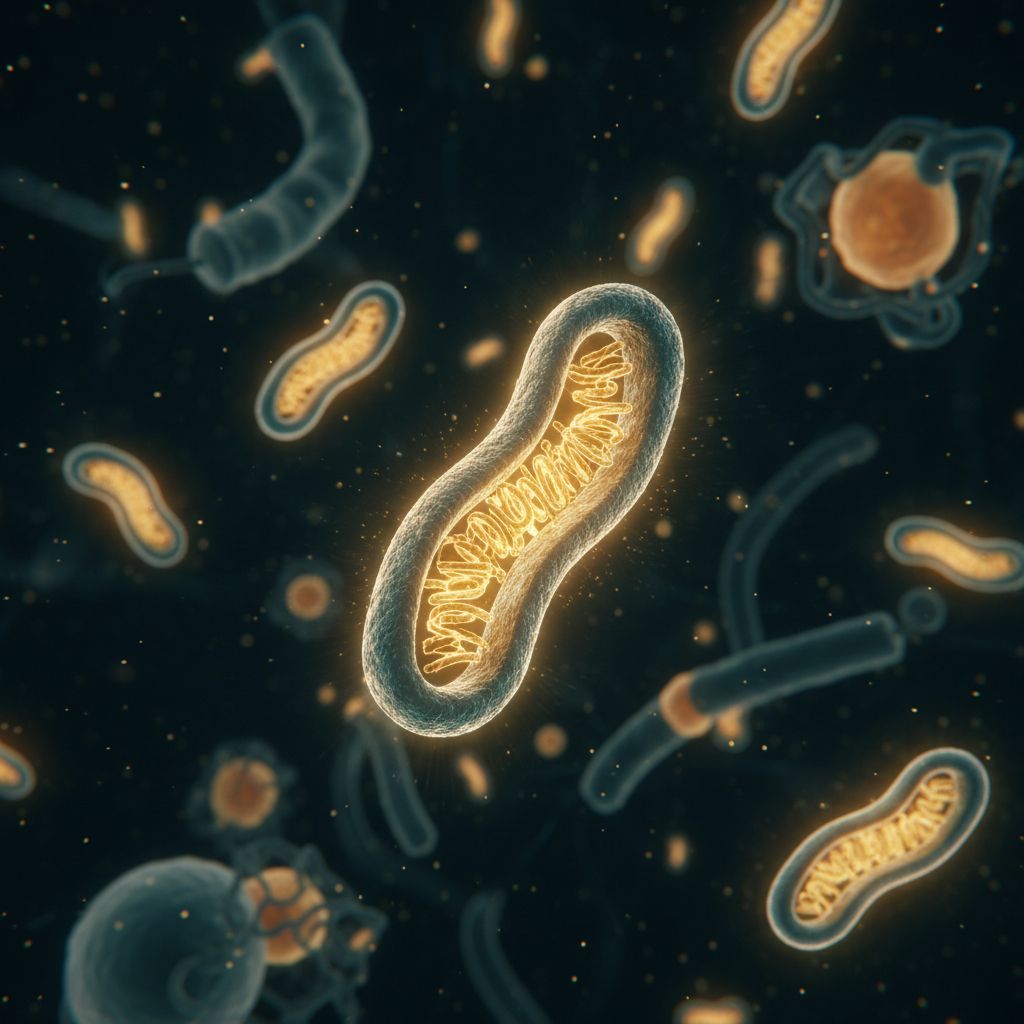
Start with the thing you already know: your cells need energy. To walk. To think. To heal. To keep your heart beating tonight while you sleep. The energy molecule is called ATP, and every single one of your 37 trillion cells makes its own ATP on site, in tiny factories called mitochondria. Think of mitochondria as little coal-fired power plants — thousands of them inside every cell.
Those power plants need a coenzyme to run. That coenzyme is NAD+. Without NAD+, the power plants can't fire. With NAD+, they can.
At 25, you have full NAD+. Every power plant in every cell is humming. You take the stairs two at a time and don't notice.
By 40, NAD+ is down 25%. A quarter of the power plants are slowing. You feel it at 3 p.m. — the first wave of tiredness that wasn't there in your 30s.
By 60, NAD+ is down 50%. Half the plants are sputtering. Muscles aren't rebuilding after workouts. Skin isn't regenerating after scrapes. Brain cells are firing but not repairing themselves as fast as they're getting damaged. The body is still running — but on half the fuel.
By 80, NAD+ is at 10-15%. This is when the multiple-system failure your father saw sets in. Sarcopenia. Memory slips. Skin that tears. Slow wounds. Eleven specialists.
Now — here is the key part, and the thing that makes this whole category different from every other "longevity" supplement on the shelf. You cannot take NAD+ directly. Swallow an NAD+ capsule and you are wasting your money — NAD+ is too large a molecule to cross the cell membrane. Your digestive enzymes tear it apart. Not a single one of those NAD+ molecules ever reaches a power plant.
But NAD+ has a precursor — a smaller molecule your body builds NAD+ out of. That precursor is called NMN (nicotinamide mononucleotide). NMN is small enough to cross the cell membrane. It is absorbed from your gut within 30 minutes. Your body has specific transport proteins — identified by Dr. Imai's lab at Washington University — that pull NMN directly into your cells.
Once inside, your cells convert NMN into NAD+ in a single enzymatic step. Within 30 minutes of swallowing the capsule, your NAD+ levels start climbing. Within a few weeks of daily use, tissue-level NAD+ begins to normalize back toward youthful levels.
The power plants start firing again. The mitochondria come back online. The sirtuins — the longevity genes — get fuel. The PARPs — the DNA repair enzymes — get fuel. And the whole tree of eleven "age-related" symptoms starts receding, not because you are treating eleven things, but because you are feeding the one thing they all shared.
One molecule. One shortage. One intervention. That's the mechanism.
NAD+ is the fuel. NMN is the delivery vehicle. CellReset is the bottle.
The Road You're On — Unless Something Changes

I do not like scare copy. My father got enough scare copy from his specialists, and it cost him his life. But I owe you the honest map of where the road goes if you close this letter and do nothing. Because every person I've ever met who ended up at the end of this road looked back at exactly this moment — the moment they almost paid attention and didn't — and wished to God they had.
Here is the typical decline by decade. This is not me. This is what the NAD+ research literature and the geriatrics textbooks already know.
Your 50s. Fatigue you can't explain away. Weight gain without a diet change. Mild memory issues — names, appointments, "what was I just doing." Sleep getting thinner. Recovery from a hard weekend taking a day longer than it used to. NAD+ is at roughly 60-70% of youth levels. The tree is still standing. The leaves are thinning.
Your 60s. Muscle loss accelerates. Joint pain becomes a daily companion. Sleep breaks up in the middle of the night. Libido drops — and with it, the quiet part of your marriage nobody talks about. Wounds take a week to heal instead of two days. You start taking naps you never used to need. This is where your first one or two diagnoses show up. Pre-diabetes. Borderline hypertension. "Creeping" cholesterol.
Your 70s. The diagnoses stack. Sarcopenia — the clinical term for "you used to have arms." Mild cognitive impairment — the clinical term for "I keep walking into rooms." Metabolic syndrome — the clinical term for "everything is drifting at once." Mobility loss starts putting a ceiling on what you can do — the stairs, the yard, the long car trip to see your daughter in Denver. You now have three or four prescriptions. Your medicine drawer has a plastic sorter in it.
Your 80s. For most Americans on this road, this is where autonomy ends. The driver's license goes. The stairs go. And then — quietly, with a speed that terrifies the families who watch it — the house goes. Assisted living. Memory care. "Managed decline." The thing your reader — yes, you — is lying awake at 3:47 a.m. terrified of becoming.
The numbers as of 2024: 69% of Americans over 65 take at least three daily prescriptions. 40% take five or more. Average annual cost of assisted living: $64,000. Average annual cost of memory care: $84,000. Average savings of Americans aged 65-74: $200,000. Do that math yourself.
This is the road you are on — unless something changes.
I am not saying CellReset reverses 80 years of biology. It does not. What I am saying — what the published science says — is that the upstream shortage that is the shared cause of this cascade is correctable, and the earlier you correct it, the further up the road you stay.
Meet Dale — The Sheriff's Deputy Who Got His Hustle Back

Dale Winters is 68. Retired sheriff's deputy out of Tallahassee, Florida. 31 years in uniform. Two grown sons. Five grandchildren. Wife named Janice who runs the household the way Dale used to run a shift — tight, no wasted motion.
Dale started feeling "old" somewhere around 66. Not one specific thing. A drift. The 3 p.m. crash that turned into a recliner nap he didn't used to need. Muscle in his forearms softening. Slow to recover after a Saturday of yard work. A bad night of sleep every three nights. Janice noticed before he did.
Janice was sitting in the salon one Tuesday reading a magazine article about NAD+. She brought the article home, put it on Dale's pillow, and said, "You're reading this tonight." Dale did. Dale, being Dale, then read the cited studies. Then he ordered CellReset on the subscription.
90 days in, Dale reports he is sleeping through the night the way he did at 50. His grip is back. He mowed the whole yard on a Saturday without the recliner nap after. Janice tells her sister he has "got his hustle back." Dale's words, on the phone with me last month: "I'm not saying I'm 30 again. I'm saying I'm me again. There's a difference, and it matters."
Meet Barbara — The Widowed Nurse Who Started Volunteering Again

Barbara Whitman is 72. Retired ICU nurse, 40 years at Munson Medical Center in Traverse City, Michigan. She lost her husband John in 2022 to a cardiac event he didn't feel coming, and for fourteen months after the funeral, Barbara felt her body collapse in a way she recognized clinically and could not treat personally.
Her energy went first. Then her sleep. Then the skin on her hands — a lifetime of washing in the unit plus the NAD+ drop of her 70s, she says — started thinning in a way that unnerved her every time she saw it in the light. She stopped volunteering at the hospital auxiliary. She stopped inviting her book club over. She stopped being Barbara.
A niece in Chicago, of all people, sent her a link to CellReset. Barbara ordered one bottle out of curiosity, then subscribed after a month. She's been on it six months now.
"I feel more myself at 72 than I did at 65," she told me in an email last week. She started volunteering at the hospital again in February — not as a nurse, but as a reader in the pediatric ICU — and she hosted the book club in March for the first time since John died. "The grief is still grief. But the body is back under me. I didn't know how much of what I thought was mourning was actually empty fuel tanks."
Meet Walt — The Nebraska Farmer Who Slept Through The Night

Walt Piasecki is 66. Third-generation farmer outside Grand Island, Nebraska. Corn and soy. Still working the land himself — no hired hand, won't accept one — and proud of it in the way only a third-generation farmer can be proud.
Walt's problem wasn't fatigue. Walt's problem was recovery. He could still do an 11-hour day in the barn. He just couldn't do two in a row. And sometime around 62, his sleep had started breaking up in 90-minute chunks — the kind where you wake up, look at the ceiling, do the math on tomorrow's work, and fall back into a shallow doze that isn't really rest.
His son's wife's father — a retired railroad man in Iowa — had been on CellReset for six months and swore by it. At Thanksgiving, that man pulled Walt aside and told him straight: "Walt, get on it. You won't believe me till you try it." Walt ordered a one-time bottle the next week. He subscribed after 30 days.
Four months in, Walt told me the cleanest line I've ever heard from a customer: "First time in eight years I've woken up actually rested. Not getting out of bed. Actually rested. I forgot what that felt like."
Meet Ruth — The Teacher Who Got Color Back In Her Hair
Ruth Calderon is 74. Retired bilingual elementary school teacher out of San Antonio, Texas. 36 years in the classroom. Nine grandchildren, most of them still at an age where they want to climb on her, and a husband named Hector who is 78 and still drives them to Padre Island in the summer.
Ruth told me, flatly, on a phone call: "I felt 85. I feel 60 now." When I asked her to be more specific, she gave me a list: "Energy for the nine grandchildren. Skin on my arms doesn't paper-tear anymore. I go to bed at 10 and sleep until 6 and I wake up ready. And — this one surprised me — my hair stylist noticed my grays started coming in with some pigment again. I've never had anyone say that to me in my life."
(Quick note on that last one: a small subset of NMN users in the research literature have reported the same thing — gray hair coming back in with partial pigmentation. The mechanism is believed to involve sirtuin activity in the melanocytes, the pigment cells at the root of the hair follicle. It is not the main thing we'd promise. It is, however, an occasionally reported thing, and Ruth insisted I include it.)
Ruth has been on CellReset for seven months. She subscribes. She told me: "Mark, I came to this country in 1962. I worked 36 years in classrooms. I raised four. I deserve my 70s. This is letting me have them."
CellReset NMN vs. The Alternatives
At this point in the letter, a reasonable person is doing the math. "Okay, Mark — but how does this actually stack up against the other options?" Fair. Honest side-by-side. Screenshot it if you want. Show your spouse before you decide.
| Factor | CellReset NMN | HGH Injections | NR (Nicotinamide Riboside) | Cheap Amazon NMN | HRT / Peptides | Doing Nothing |
|---|---|---|---|---|---|---|
| Monthly cost | $39 | $1,500-3,000 | $50-80 | $15-25 | $200-600 | $0 now / $$$$ later |
| Mechanism | NAD+ restoration at root | Growth hormone flood | Less efficient NAD+ precursor | NAD+ (under-dosed) | Hormone-specific only | None |
| Clinical 500mg dose | Yes | N/A | Varies | Usually 250mg | N/A | — |
| Made in USA | Yes, GMP-certified | Varies, many overseas | Varies | Often China | Compounded, varies | — |
| Prescription required | No | Yes (and often illegal off-label) | No | No | Yes | — |
| Needle required | No — capsule | Yes — daily injection | No | No | Often yes | — |
| Side effects | Minimal reported | Cancer risk, edema, diabetes | Mild GI in some | Varies | Clot risk, mood, organ strain | The cascade itself |
| Scientific track record | Harvard 2013, 2016+ trials | Mixed, legal gray zone | Older evidence, being surpassed | Compound is same, dose is wrong | Specific to each hormone | — |
| 60-day guarantee | Empty-bottle OK | No | Varies | Varies | No | — |
The comparison every honest American should look at hardest is the cheap Amazon NMN column. Most of the negative reviews on NMN — "I tried it, didn't feel anything" — come from 250mg bottles that are almost certainly under-dosed, unstable, and in many cases not even the compound the label claims. We stuck with the 500mg clinical dose on purpose because we want you comparing against the published trials, not against a warehouse bottle with a question mark in it.
Before You Decide — Let's Handle The Five Real Concerns
1. "I've never heard of this — is it safe?"
I understand the instinct. It has kept you safe from plenty of things that deserved skepticism. Here's the answer. NMN has been studied in animal trials since the early 2000s and in human trials since 2016. The first human safety trial gave NMN at doses up to 500mg and reported no serious adverse effects. The 2021 Keio University trial — 12 weeks, older men — reported no meaningful side effects at the clinical dose. The FDA clarified NMN's status as a legitimate dietary supplement in 2023. It has one of the cleanest modern safety profiles of any compound in the longevity space. Compare that to the ten-year toxicity profile of most of the prescriptions in your father's pill sorter.
2. "Doesn't my doctor know about this?"
The honest answer is structural, not personal. Your doctor gets 14 minutes per visit. He carries 2,400 patients. He was trained at a medical school where continuing education has been sponsored by pharmaceutical companies since 1997 — the year direct-to-consumer drug advertising was deregulated. Medical schools teach roughly zero hours on NAD+ metabolism therapeutics. The drug rep who walked into his office this week brought sandwiches and a new statin. There is no NMN rep. There is no free lunch. This is not your doctor being a bad guy. It is the system being rigged — and your doctor being too overloaded to fight it.
3. "Isn't this that Silicon Valley longevity thing?"
Short version: no. Long version: the research this product is built on came out of Harvard Medical School in 2013, Washington University in St. Louis, and Keio University in Japan. These are straight-laced, grant-funded, peer-reviewed academic labs. Yes, these days it comes up on Joe Rogan's podcast — but Harvard was ten years ahead of the podcast. We are not selling you a tech-bro fad. We are selling you published biology your doctor's medical school forgot to teach.
4. "I'm on a fixed income — how is this worth it to me?"
Fair question, and the one I care about most. Let me do the math with you, in 2026 dollars, at a kitchen table.
- One visit to a cardiologist: $300-400 with your copay.
- One month of an anti-aging prescription (HRT, statin, PDE5 inhibitor, etc.): $150-600.
- One month on Aricept if the memory gets worse: ~$400.
- One CellReset subscription: $39, free shipping.
If CellReset keeps you out of one specialist visit every other month, it has already paid for itself twice over. If it keeps you off one prescription, ten times over. If it keeps you out of a nursing home for one additional year, it has saved you $64,000. These are not fuzzy numbers. These are the numbers your insurance actuary is running about you right now, and betting against you on.
5. "What if it doesn't work for me?"
Then you don't pay. I'll say it again because I mean it: you send the bottles back within 60 days — full, half-empty, completely empty, it doesn't matter — and we refund every dollar you paid. No retention call. No "customer satisfaction specialist." No form. The only risk you are taking right now is continuing to do exactly what is not working.
Your Offer
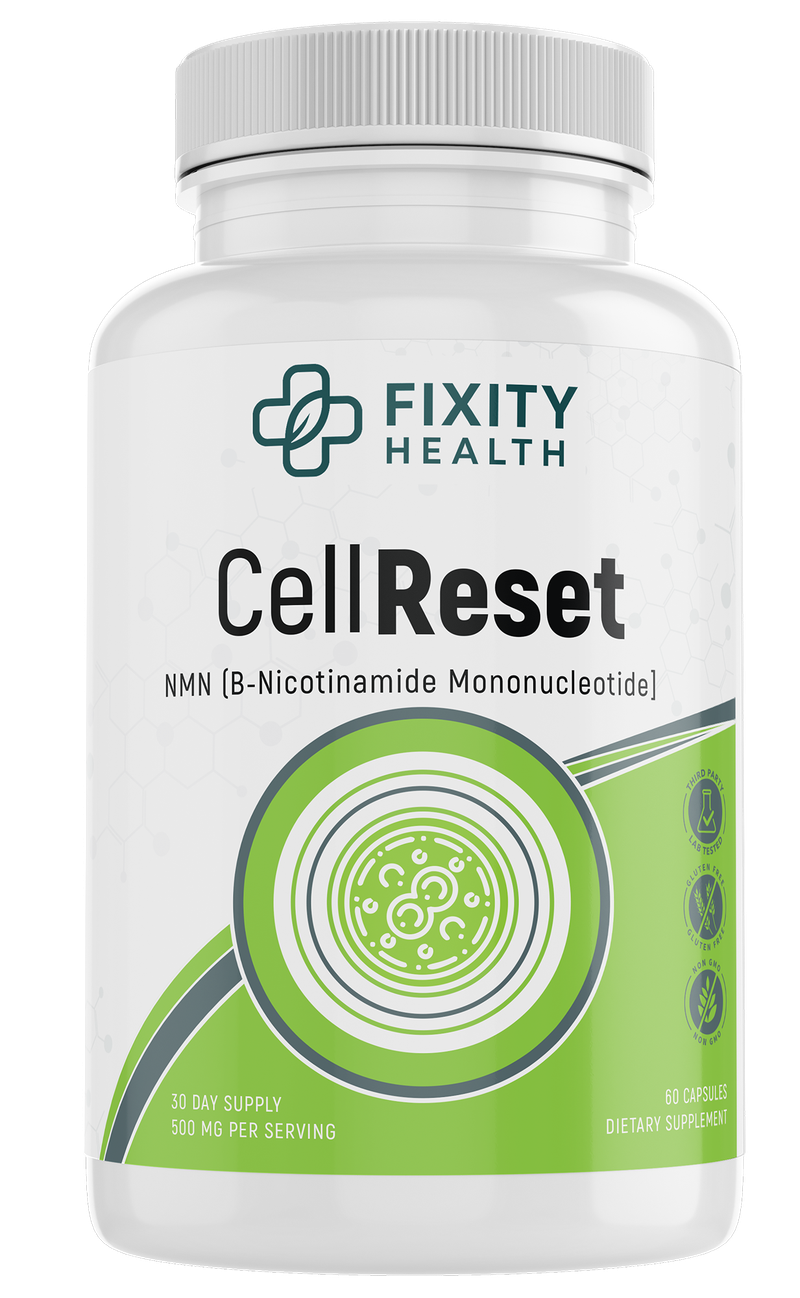
CellReset NMN — 500mg Pharmaceutical-Grade NMN
Clinical dose. Made in USA. GMP-certified. Third-party tested.
MONTHLY SUBSCRIPTION — BEST VALUE
A fresh 30-day bottle ships to your door every month. Shows up like clockwork. Cancel in 30 seconds from your phone.
Start My $39/Month Subscription ▸ONE-TIME ORDER
Single 30-day bottle. No subscription. Good for trying before you commit.
Order One Bottle — $58.95 ▸Do the specialist math:
- Eleven-specialist model: ~$300 copay × 11 visits/year = $3,300/year in copays alone, plus $200-600/month in prescriptions = easily $10,000+ per year.
- CellReset monthly subscription: $39 × 12 = $468 per year.
- You save $9,600+ per year — and address the root instead of eleven branches.
Why Subscribe — The Honest Answer
This is one of the few places in this letter where I'm going to ask you to trust me on the science and pick the subscription.
NAD+ restoration is cumulative. The Harvard mice study ran 8 days because mice are small and their tissue turns over fast. The human trials that produced the headline walking-speed and muscle-performance numbers ran 12 weeks minimum. Most of the tissue-level NAD+ restoration research used 6- and 12-month protocols. Your body has been slowly draining this fuel for 20 or 30 years. You do not refill it in a week.
Subscribing isn't a marketing trick. It's the protocol that actually matches the research. The reason we priced it at $39/month with free shipping is so that the Americans who benefit most — retirees, veterans, people on fixed incomes — don't fall off the protocol in month two because they forgot to reorder, or because the shipping charge nudged them to skip a month.
Cancel anytime. Free shipping every month. $39 flat.
The 60-Day Return Policy — No Games

Take CellReset for up to 60 days. Take it every day. Give it a fair shot — the research says the real window is 8 to 12 weeks, so use the full time.
If your energy isn't climbing, your sleep isn't deepening, your recovery isn't quickening, and you don't feel the decades starting to unwind — send back the bottles. Empty is fine. Partial is fine. We refund every dollar. No restocking fee. No retention call. No interrogation.
You either feel it or you don't pay for it.
Three Free Bonuses With Any Order
When you order today, I'm including three PDF guides I've never made available outside of FixityHealth subscribers. You'll get them by email within 10 minutes of checkout — even if you only order one bottle, even if you end up sending it back empty on day 59 for a full refund. The guides are yours to keep either way.
Bonus #1 — The NAD+ Protocol
A 47-page field guide to maximizing NMN absorption. Which foods naturally boost NAD+ (and which ones burn it). The sleep architecture that doubles overnight NAD+ synthesis. The specific lifestyle levers — fasting windows, cold exposure, the two-meal timing pattern — that multiply what the capsule can do. Written for a grandmother, not a biohacker.
Bonus #2 — The 11-Specialist Shortcut
A self-assessment guide that walks you through each of the eleven most common "age-related" complaints your doctor is likely to send you to a specialist for — fatigue, memory, blood sugar, sleep, skin, joints, libido, slow healing, mood, eyes, plumbing — and tells you in plain English which ones are most likely downstream of NAD+ depletion versus genuinely separate issues. The guide I wish Mom had had in 2015.
Bonus #3 — The 30-Day CellReset Tracker
A printable daily journal with the specific biomarkers to track as NAD+ comes back online — energy at 3 p.m., recovery after exertion, sleep quality, grip strength, skin bounce-back. Day 0, day 15, day 30. Seeing your own numbers climb is, for most customers, the moment they know.
Total bonus value: $93. Yours free with any order today.
A Note About This Batch
Honest word about why this matters now, not three months from now. I am not going to run a fake countdown timer on you. I'm going to tell you the supply-chain truth and let you decide.
Pharmaceutical-grade NMN at the stability and purity we require is not something you manufacture in a New Jersey warehouse. There are a handful of facilities worldwide capable of producing NMN at research grade — and the raw material cost has risen 19% in the last four months due to precursor feedstock constraints we do not control.
Our current batch was locked in at March 2026 pricing. The next batch — already on order — will cost us meaningfully more to produce. The commitment: if you start your subscription during the current batch, your $39/month price is locked in for the lifetime of that subscription. Not a year. Lifetime. New subscribers starting after this batch sells through will begin at the higher price.
If you're on the fence, the fence is about to get more expensive to sit on.
The Decision In Front Of You
Option one: Close this letter. Go back to the eleven-specialist model. Let the tree keep losing branches, one waiting room at a time. Hope the road doesn't lead where your parent's road led.
Option two: Try CellReset for 60 days. Risk nothing. Feel the decade start to unwind, or get your money back.
Click the button below. Choose the subscription if you want the actual research protocol. Choose the one-time bottle if you want to test the waters. Either way, you'll have CellReset in your hands inside a week — and a very different feeling at 3 p.m. inside a month.
Frequently Asked Questions
1. How quickly will I notice anything?
Most subscribers notice the 3 p.m. energy shift within 10-14 days. Sleep quality usually deepens by week 2-3. The bigger structural shifts — muscle recovery, skin, joint, walking speed — tend to show up between day 60 and day 120, which matches the clinical trial timelines. NAD+ restoration is slow and steady, not a stimulant buzz. If you're expecting a jolt, you'll be disappointed; if you're expecting the decade to start unwinding, you'll be right.
2. What time of day do I take it?
Morning, with breakfast or within an hour after. NAD+ is circadian — your body naturally produces it in rhythm with the day/night cycle, with peak synthesis in the morning. Taking NMN in the morning aligns with the body's own production window. Avoid taking it right before bed for the first two weeks — a small number of users report unusually vivid dreams while the brain adjusts to fuller cellular energy. If that happens, shift to morning.
3. Can I take it with my other medications?
For the vast majority of people, yes. NMN does not interact with the major prescription classes (blood pressure, statins, blood thinners, anti-depressants, cholinesterase inhibitors) at the metabolic pathway level. It operates on a completely different machinery — the NAD+ coenzyme system. That said, have the conversation with your doctor. Take the bottle to your next appointment.
4. What if I already take metformin, statins, or blood pressure meds?
Most customers on these medications report that CellReset complements them rather than conflicts with them. Metformin is an NAD+-adjacent drug — it modestly activates AMPK, which interacts with sirtuins, which interact with NAD+ — so the combination often makes sense. Statins have no known NAD+ pathway interaction. Blood pressure meds, same. Again — talk to your doctor, never self-adjust prescription dosing, but this is generally a friendly combination.
5. How long until I see the full benefit?
The research protocols ran 12 weeks to 12 months. Most customers report their "this is real" moment somewhere between week 8 and week 16. If you're subscribing, plan for six months of continuous daily use before you judge the full effect. Your body has been running on 50% NAD+ for decades. Give it a full season to come back.
6. Is it safe long-term?
Yes. NMN has one of the cleanest modern safety profiles of any compound in its category. Human trials out to 12 months have shown no cumulative organ strain. Animal studies going back 15+ years show no toxicity at clinical doses. Compare that to the long-term profile of most of the prescriptions on the average 70-year-old's medication list.
7. Why 500mg specifically?
Because that's the dose used in the research. The 2016 first human safety trial went up to 500mg. The 2021 Keio trial used 250mg-500mg. The headline NAD+ restoration numbers in tissue-level studies used 500mg. Most retail NMN is 250mg — half the clinical dose — because it is cheaper to put 250mg in a capsule than 500mg. We deliberately hit the full research dose so that what you take matches what was published.
8. What's the difference between NMN and NR?
Both are NAD+ precursors. NR (nicotinamide riboside) is one enzymatic step further upstream from NAD+ than NMN is. Your body has to convert NR to NMN before converting NMN to NAD+. NMN skips the first step. Recent comparison research — particularly Dr. Imai's lab at Washington University — has found NMN to be more efficient per milligram in raising tissue-level NAD+. NR still works; it just takes more of it to hit the same target. We chose NMN for efficiency.
9. Who shouldn't take it?
Pregnant or nursing women — no human safety data in that population. Children under 18 — NAD+ depletion isn't an issue at that age, so there's no reason to take it. Anyone undergoing active cancer treatment should check with their oncologist before starting, because NAD+ metabolism interacts with cellular growth pathways and should be coordinated with the treatment plan. Everyone else — generally fine, but your doctor has the final word.
10. Where is it manufactured?
CellReset is manufactured in an FDA-registered, Good Manufacturing Practice-certified facility in the United States. Every batch is third-party assayed for purity, potency, heavy metals, and the stability of the NMN molecule itself (NMN is notoriously unstable if improperly manufactured or stored, which is one of the reasons cheap NMN often doesn't work — by the time it hits your bloodstream, it's half-degraded). Certificate of analysis available on request.
To your health,

Mark Edwards
Founder, Fixity Health
Orlando, Florida
P.S. One sentence version: Aging isn't eleven diseases — it's one molecular shortage your body stops producing at 40. Refill the fuel and the symptoms recede on their own. Harvard proved it in 2013 on video. Your doctor wasn't taught it. You just were.
P.P.S. The current batch is price-locked at $39/month. Raw material cost for pharmaceutical-grade NMN rose 19% in the last four months, and the next batch will cost us meaningfully more. Subscribers who start during this batch are locked at $39/month for the lifetime of the subscription, not a year. New subscribers after the current batch sells through will begin at the higher rate. This is supply chain, not scarcity theater. Decide from the kitchen table, not the countdown clock.
P.P.P.S. If I had known about the 2013 Harvard paper in 2015, I believe with my whole heart my father Tom Edwards would still be here. He would be 79 this year. He would be at my daughter's graduation in June. He is not, because nobody handed him this letter and nobody handed him this bottle and the eleven-specialist shell game ran its course on him the way it is running its course on the people you love right now. Do not waste the fact that you have this letter in your hand. Subscribe. Forward it to the person you are thinking about as you read this. The bottle is $39. The grandchild who climbs onto your lap next Christmas — and calls you by name — is priceless.