
Listen —
Before I get into any of this, I want you to try something. Right now. Where you're sitting.
When you stood up from your chair this morning — what did you do?
Not the big stuff. The small stuff. The stuff you don't even notice you're doing anymore.
Did you brace your hand on the armrest before you pushed up?
Did you pause for half a second at the top, waiting for your knees to catch up?
Did you roll your shoulder forward because something in your neck went click?
Did you feel for the edge of the counter with your hand as you walked to the coffee pot, because the first few steps in the morning feel like you're walking on a boat deck?
I call that the silent calculation. Left knee — how bad today? Right shoulder — can I lift the grandkid or do I fake it? Back — do I take the stairs or find the elevator? Eyes — do I admit I can't read the menu or do I tilt it toward the candle and pretend?
You don't talk about the silent calculation. You don't tell your spouse. You don't tell your doctor — not really. Maybe you joke about it, the way people joke about things that scare them a little.
But you're running the calculation every single day, a hundred times a day, and you've been running it for years.
That calculation — the quiet retreat from the world's details, the things you've stopped doing because it's just easier not to — isn't aging. It's the most misunderstood symptom in modern medicine.
I know that sounds like a big thing to say. I'm about to prove it to you.

My name is Mark Edwards. I founded a company called Fixity Health about twenty years ago, out of Orlando, Florida. We make practitioner-grade supplements at an FDA-registered, GMP-certified facility in Utah — not in somebody's garage. You may know us from Flex Force 5x, our five-type collagen joint formula, or OcuFortress, our eleven-ingredient eye health stack.
I'm not a doctor. I'm not a researcher. I'm not a wellness guru with a ring light and a podcast. I'm a guy who builds formulas for a living, because almost twenty years ago, someone I love was suffering and I couldn't find anything on the shelf that actually worked. So I started reading studies. Then I started calling researchers. Then I started building.
That's the whole story of Fixity Health. One person I loved. One problem nobody was solving properly. I tried to solve it. Then another problem showed up. Then another. Twenty years later I'm still at it.
This letter is about my newest one. It's called Clean Core, and it took me three years to build. Forty-seven studies pulled and read. Fourteen formulations tested in our development lab before I was willing to put my name on one. A retired gastroenterologist who didn't want to be named in the marketing (so in this letter I'll call him Dr. Delgado) sat with me through most of it. A compounding pharmacist (same deal — I'll call him Walt Kovacs) walked me through what was broken at the drugstore counter. And a plumber I met in a diner during month four gave me the analogy that finally unlocked it for me.
I'm going to tell you the whole thing. All of it. The plumber in the diner. The 72-year-old woman whose main line he'd cleared that morning. The Elvis autopsy I read on my laptop with my coffee going cold. The Saturday afternoon at a picnic table in a retired gastroenterologist's backyard where he handed me a printout I haven't stopped thinking about. The drive to a compounding pharmacy where I learned why every cleanse you've ever tried was engineered to fail you.
Pull up a stool. This is going to take about fifteen minutes. I'm writing it the way I'd tell it to a friend in a booth, not the way a corporate supplement marketing team would write it, because this topic doesn't deserve the corporate supplement tone. It's too important and too private, and I'm tired of watching people who should be fine walk around blaming their birthday for something that is fixable.
But first —
You're not aging the way you think you are.
That thing where you hit 2 PM and your eyelids start feeling like they're made of wet cardboard? That's not age.
That weight around your middle that won't budge no matter what you do? Not age.
The brain fog. The joints that sound like bubble wrap getting up from the couch. The skin that used to glow and now looks like drywall. The mood that flips over nothing. The bloat that makes you look three months pregnant by dinner. The way you've started pretending you still see the fine print on the menu. The silent calculation before every staircase —
None of it is your birthday catching up with you, buddy.
It's something else entirely.
Something sitting about eighteen inches south of your belly button right now, as you read this…
And here's the weird part —
Most people never once think to look there.
Not their doctor. Not their spouse. Not the guy who wrote the article they read last week about "aging gracefully." Nobody.
Because the symptoms show up in your face, your joints, your head, your mood — everywhere EXCEPT where the actual problem lives.
And once I tell you what it is, you're going to be pissed. Because you've been lied to about it your entire adult life — by your doctor, by the drug companies, by the fiber commercials with the smiling grandma in the yellow sweater, by the "15-day cleanse" scams the FTC keeps slapping with lawsuits (I'll get to one specific thirty-million-dollar cleanse bust in a minute — public docket, I pulled it up myself in the middle of writing this).
Stick with me. I dug into the research for a long time before I was willing to put my name on what came out the other end. I verified the whole thing with the retired gastroenterologist I consulted, who now gives this formula to his own seventy-two-year-old mother every single morning.
Fair warning — there's no cute way to talk about this stuff. I'm going to use the word "poop" and words worse than that. If that bothers you, hit the back button right now. No hard feelings. The rest of us need to have a grown-up conversation that nobody else is having.
Everyone else — pull up a stool.
The Plumber In The Diner And The 72-Year-Old Woman Whose House He'd Just Saved

I'm going to tell you exactly how I got dragged into this, because I didn't go looking for it. It found me.
This was about fourteen months into the research for what would eventually become Clean Core. I was already deep in it. I'd read most of the studies on my pile by that point. I was confused. Every new paper sent me two more directions. I was starting to wonder if I was ever going to be able to put this thing together.
I was traveling through a small town — not going to say which one, Ray asked me not to — sitting at a counter in a diner that had the kind of laminated menus where the coffee picture had faded to gray. A guy sat down next to me with a coffee cup the size of a soup bowl. He had hands like bricks. Forearms like ham hocks. A voice like gravel in a cement mixer. He wore a Carhartt jacket that had seen the inside of a thousand crawl spaces, and there was a smear of something black on his thumbnail that wasn't going to come off for a week.
He was dipping his toast in the yolk of his eggs like a man who had earned it.
Ray. Forty-three years as a plumber.
We got to talking, the way you get to talking in diners. I told him I was working on a health product. He asked what kind. I said it was complicated.
He raised an eyebrow. "Try me."
I told him. The short version. Chronic constipation. Waste buildup. Symptoms showing up everywhere else in the body. I told him I was stuck because I couldn't find the right mental model for it, the right way to explain to people what was happening.
Ray put his fork down.
"Mark. You know what the number one house call I run on older folks is?"
I figured he'd say water heaters. Or garbage disposals. Something clean.
"Water heater?"
He gave me a little half-smile. The kind of smile a guy gives you when you've guessed wrong and he's been waiting for it.
"Nope."
"Okay, I give up. What?"
He set his coffee down. Leaned forward a little.
"Blocked main line. Sewage backs up into the house. Homeowner thinks the toilet's broken, the sink's broken, the whole plumbing system is shot. Wife's crying. Husband's yelling. Kids are trying to take showers and getting stuff they shouldn't be getting. It's a nightmare."
He took a sip of coffee.
"I go down there. I pull up the cleanout. And you know what I find? Twenty years of grease, roots, and stuff they shouldn't have flushed, sitting in a pipe that used to be four inches wide and now has about an inch of clearance left. Maybe less. Sometimes the size of a pencil."
"Yeah. So what do you do?"
"I clear it. Five minutes with the right tool. Family thinks I'm Jesus. They offer me beer, lasagna, I once got a fishing rod from a guy. And you know what they tell me every single time?"
"What?"
He pointed his fork at me.
"They say — 'Ray, we had NO idea that was the problem. We were about to rip out the whole kitchen. We had a contractor out last week looking at the tile. My wife was googling new vanities. We thought the toilet was broken. We thought it was the washing machine. We were thinking about selling the house.'"
He shook his head.
"Every. Single. Time. The real problem was in a pipe they couldn't see. Forty feet away. Under the yard. In the dark. Where nobody looks."
Then he paused.
"I just came from one, matter of fact. This morning. That's why I stopped for breakfast — I was gonna skip it, but I felt like I'd earned it."
He told me about her.
Seventy-two years old. Lived alone. Husband died four years ago. She'd been having problems for six weeks — slow drains, weird smells, the downstairs toilet gurgling at night. She'd called a guy out. He'd replaced the wax seal. Didn't fix it. Called another guy. He'd snaked the toilet. Didn't fix it. Called a third guy. He'd looked at her for fifteen minutes and told her she needed a whole new bathroom, which was going to be twelve grand because she had old tile that would have to be cut out.
She'd called her daughter crying. She didn't have twelve grand. She was going to have to take a reverse mortgage on the house her husband had built for her.
The daughter called Ray on the recommendation of a neighbor.
Ray got there at 7 AM. He didn't go inside. He walked around to the cleanout in the yard. He pulled the cap. He ran a camera thirty feet out toward the street. And forty-two feet down he found it — a tangled mass of tree roots from the oak in her front yard that had slowly, over fifteen years, grown through a hairline crack in a section of cast iron and built a dam.
"Took me eighteen minutes to clear it," Ray said. "Used a hydro jetter. She's got a working house again. I charged her three hundred and twenty dollars and she handed me a plate of lemon bars out of her kitchen because she said she hadn't known who else to thank."
He stopped chewing. Set his fork down. Looked at me dead on.
"You wanna know the crazy part, Mark?"
"What?"
"Three plumbers. Fifteen hundred dollars spent. Almost twelve grand quoted. She was about to reverse-mortgage her house. And nobody — not one of those three guys — walked around to the cleanout in the yard and pointed a camera at the pipe. They all looked inside the bathroom. They all looked at the porcelain. They all looked at the seals and the valves and the tile. Nobody looked at the pipe."
I was staring at him. The fork I'd been holding was just floating there in midair.
He said —
"They never think the problem is in the pipe."
I thought he was still talking about houses.
He was watching me to see if I'd catch it.
I didn't.
So he hit me with it.
"That's what happens to people, too."
"What do you mean, people?"
"Think about it, Mark. People come into my life complaining about the same things over and over, when we're chatting at jobs. 'Ray, my back hurts. Ray, my skin's a wreck. Ray, I can't sleep. Ray, I got no energy. Ray, my wife says I'm gettin' grumpy.' They go to their doctor. The doctor runs ten tests. Nothin' comes up. They pay their two grand deductible. They go home. They still feel like hell."
He tapped his belly with two fingers.
"But nobody looks at the pipe. Nobody ever thinks the problem is in the pipe. The doctors are the third plumber — they're looking at the porcelain."
And THIS is where it got weird for me —
Because he then looked at me with a face I'm not going to forget, and he said:
"You ever seen the autopsy report on Elvis Presley's colon?"
I damn near choked on my toast.
I Almost Didn't Drive Home That Night
Here's the thing I want to tell you, before I keep going.
I didn't believe Ray.
I want to say I did. I want to tell you I sat there at that diner counter and felt the lightning bolt and immediately drove home like a man on a mission. That's not what happened.
What happened is: I paid the check, I walked out to the rental car in the diner parking lot, and I sat behind the wheel for about ten minutes with the engine off, looking at the sun coming up over the gas pumps across the street.
And I argued with Ray in my head.
This is a colorful guy with a colorful story. He's a plumber. He's not a doctor. He's making an analogy that sounds clever in a diner at 7 in the morning over eggs and coffee. None of this is actual evidence of anything. People die from heart attacks and strokes and cancer and Alzheimer's, not from clogged pipes. If this were real, somebody would have figured it out by now. My doctor would know. His doctor would know. Fourteen months of research and I would have read it somewhere.
I told myself all of that. Out loud. In the rental car. With nobody listening.
And I almost drove to the airport instead of the hotel.
I'm going to tell you what stopped me. Two things.
One — Ray hadn't been trying to sell me anything. He'd been eating his eggs. He didn't know I made supplements. He didn't know I was deep in research on the colon. He'd just told me what he saw, every week, in actual houses, with actual plumbing, owned by actual older people who were spending their grandkids' inheritance on the wrong contractor.
Two — the Elvis question. The way he'd asked it. You ever seen the autopsy report on Elvis Presley's colon? That was a specific question about a specific public document. Either it was real or it wasn't. Either I could look it up in fifteen minutes or I couldn't.
I started the car.
I drove to the hotel.
The Elvis Moment That Made Me Put My Fork Down And Drive Home

I hadn't seen the autopsy.
I sat on the edge of a bad hotel bed and I looked it up on my laptop. And buddy, I wish I hadn't looked during lunch.
Elvis Presley died in 1977. Official cause, heart attack. Unofficial cause — and this is on record from the autopsy performed by Dr. Jerry Francisco, the Shelby County medical examiner — his colon was what gastroenterologists call a "megacolon."
Here's what that means in plain English.
A normal adult colon is about two to three inches wide, and four to five feet long.
Elvis's colon, at 42 years old, was five to six inches wide and eight to nine feet long. Stretched out like an old inner tube that had been sitting in the sun for a summer.
And it was packed — and I mean PACKED — with what the medical report called "claylike material."
How much?
Over thirty pounds.
Thirty.
Pounds.
Let me say that again.
Thirty pounds… sitting inside a 42-year-old man.
Not in his fat. Not in his muscle. Not in his bones. Sitting in a pipe that was supposed to move waste OUT of his body, and instead had become a warehouse.
The man weighed about 260. Thirty of those pounds — more than a tenth of his body weight — was sewage that his plumbing had been too clogged to pass. For years. Maybe for decades.
His personal physician for years, Dr. George Nichopoulos, was on record about Elvis's gut problems long before he died. Nichopoulos knew. He just couldn't fix it in time. There wasn't a tool.
Now here's where your eyes should go wide.
Because Elvis wasn't an outlier. Elvis was just the guy whose pipe finally gave out in front of a coroner.
And this is the part nobody talks about —
You can "go" every day and still be rotting inside.
The daily deposit comes out. The old stuff — the stuff pasted to the walls of the pipe like Ray's grease and roots — stays put. For years. Sometimes decades. Building up. Getting hotter. Leaking.
I closed the laptop. I stared at the wall of the hotel room for a while. The argument I'd been having with myself in the rental car was over. Ray wasn't the colorful guy with the colorful story anymore. Ray was the guy who'd just dropped a thirty-pound piece of evidence on my lap and walked away.
I called the retired gastroenterologist I'd been consulting with on the formula. Thirty-two years in GI practice. Asked not to be named in the marketing — he was worried about patients thinking he was endorsing a supplement from a founder he'd consulted with, which wasn't exactly what he was doing — so in this letter I'm going to call him Dr. Delgado. He knows I'm calling him that. He laughed when I told him. He said every doctor he knows has a Dr. Delgado name they use for this kind of thing.
I called him from the hotel parking lot and told him what Ray had said.
There was a long pause on the phone.
Then he said, "Mark. Fly home. Come over Saturday. Bring a notebook. And bring your honest ears — because I'm going to tell you some stuff I couldn't tell patients when I was still billing insurance."
The Picnic Table Lecture (And The Printout That Changed My Mind About Everything)

Saturday morning I drove to Dr. Delgado's place. He's got a low house with a back patio and a picnic table under a tree. He had two beers and a manila folder sitting on the table when I got there.
He pushed the folder across and said, "Before we talk, read this."
Inside was a printout of a study. Lead author: Dr. Chaoran Ma. Published out of Mass General Brigham — a Harvard affiliate. Presented at the Alzheimer's Association International Conference in 2023.
110,000 people. Tracked over years. Looking at the relationship between chronic constipation and cognitive function.
The finding:
People with chronic constipation had cognitive decline equivalent to three full years of extra brain aging.
Three years.
Let me say that again.
Three. Full. Years. Of. Extra. Brain. Aging.
You're 58. You're walking around with the brain of a 61-year-old. Because your pipes are clogged.
I looked up from the printout. Dr. Delgado was watching me.
He said, "Flip the page."
On the next page was a quote from Christopher Weber of the Alzheimer's Association, commenting on the Ma study:
"We know that it is essential for overall good health to regularly eliminate waste from the body. If that does not happen, we may retain toxins that negatively impact our health in a variety of ways."
And below that, a quote from Dr. Rima Kaddurah-Daouk at Duke:
"It's time to stop seeing Alzheimer's as just a disease of the brain, but rather as a disease of the brain, liver and gut."
Dr. Delgado tapped the page.
"Duke. Harvard affiliate. Alzheimer's Association. This isn't alternative medicine. This is the front of the field, Mark. This is what the researchers at the top of my field are saying at the biggest Alzheimer's conference on the planet. And most of my old patients have never heard any of it."
He took a long pull from his beer.
Then he said something I'm going to remember for a long time.
"Mark, I spent 32 years telling people their symptoms were unrelated. Fatigue was one thing. Fog was another. Bloat was another. Aches were another. We'd run separate tests for each one. Separate specialists. Separate deductibles. Half the time, all four of those symptoms were the same problem. One pipe. One backup. One organ that nobody in the chain was trained to look at as a root cause. Every one of us — me, the cardiologists, the rheumatologists, the neurologists — was trained to look at our own organ and stay in our own lane."
He paused. Looked at the mesquite branches for a second.
"The worst part isn't that we missed it. The worst part is what it took from those people. Every one of them had stopped doing things. One had stopped gardening because her knees were shot. One had stopped driving at night because his eyes didn't work the way they used to. One had stopped hosting Thanksgiving because her bloat made her self-conscious. They'd built their whole late lives around a retreat. A quiet retreat from the world's details."
That phrase stuck with me. The quiet retreat from the world's details. I wrote it down in my notebook.
I sat there at his picnic table and I thought about my own version of it. The dinner invitations I'd started declining. The Saturday morning bike rides I used to do that I'd quietly stopped doing about two years ago and never said anything to anybody about. The fact that I now sat in the aisle seat on the plane, every time, because I'd stopped trusting my knees to climb over a stranger to get up. The fact that I'd started buying my pants a size larger and telling the salesguy "I just like a little more room these days" as if a forty-eight-year-old has any business needing more room around his middle than a thirty-five-year-old.
A quiet retreat from the world's details. It was such a perfect phrase that it made me want to put my head down on the picnic table.
"And most of them, I think now, had a pipe problem I wasn't trained to see."
He took another pull.
"I'll tell you something else. Dr. Mark Hyman — I don't agree with Hyman on everything, but he nailed one thing. He said, and I'm paraphrasing but it's close — your entire immune system is protected from the toxic environment in your gut by a layer only one cell thick. That layer covers a surface area the size of a tennis court. And it's basically containing a sewer."
He paused.
"One cell thick. Tennis court. Sewer. Think about that for a minute."
I did. I'm still thinking about it.
Stop. Read that sentence again. One cell thick. The size of a tennis court. Containing a sewer. The thing standing between the contents of your colon and the bloodstream that feeds your brain is a single layer of cells stretched over the area of a tennis court. That's the entire defense. That's it.
Here's what that actually means for you — and I want you to sit with this for thirty seconds before you keep reading.
If that one-cell wall has been getting beat up for thirty years by sludge that should have moved out of your body decades ago, the wall develops gaps. The sludge starts leaking through the gaps. Your bloodstream — the same one that feeds your brain — starts carrying the leak.
That's the moment I knew I had to build Clean Core.
Not because I wanted a new product to sell. Because I'd just realized the person I love, the one who got me started in this whole business twenty years ago — the reason Fixity Health exists — had been running that silent calculation every morning for years, and I had never once thought to look at the pipe.
The Mirror, Six A.M., The Angle You Don't Show Your Spouse
I have to stop and tell you about something that happened that next Monday morning, before I get to the rest of the science. Because if I just keep stacking studies on you, I'm going to lose you. And the studies are not the point. The studies are the proof. The point is what's happening to you in your own body, in your own house, in the small private moments nobody else sees.
So here's mine.
That Monday morning, I woke up at 5:48. I didn't need to be up until 6:30. I lay there for a while in the gray, listening to the house, doing the version of the silent calculation you do when you wake up — the inventory. Back. Knees. Shoulder. Mouth. Eyes. Cataloging what hurts before you commit to standing up.
I got up. I padded to the bathroom in the dark. I flipped on the light over the sink.
And I looked.
You know the angle. The morning angle. Top light, no shave yet, the puffiness around the eyes that sleep didn't fix, the slight gray under the cheekbones that you hope will go away after coffee and never quite does. The pillowcase line on the cheek that takes longer to fade out every year. The little roll of skin under the chin that your shaving razor goes around now instead of through.
I looked at the guy in the mirror.

And here's the part I don't like saying out loud, and the part I'm going to say anyway because that's what this letter is for —
I didn't recognize him.
Not in a dramatic, where-did-the-years-go way. In a small, specific way. The face in the mirror looked like a tired version of a guy I used to know. Like somebody had photocopied my face onto a slightly thicker, slightly grayer piece of paper. The skin was the same. The bones were the same. But there was a fog over the whole thing. Like the photo had been left in the sun.
I leaned in closer.
I thought to myself: Jesus. When did I start looking like this? When did the puffiness become a permanent fixture instead of a Tuesday-after-a-late-Monday thing? When did the gray under my cheekbones become the color my face is, instead of the color my face becomes when I'm tired?
I'd been blaming my birthday for that face for at least three years.
I'd been telling my reflection "well, that's forty-eight" for at least three years.
Ray came back to me, standing there at the sink.
They never think the problem is in the pipe.
Forty feet under the front yard. In the dark. Where nobody looks.
I shaved. I made coffee. I sat down at my laptop. And I went back to work.
That's the morning the research stopped being a research project for me.
Why Your Doctor Has Never Once Mentioned Any Of This To You
Now here's the question any reasonable person asks.
"If this is real, how come my doctor has never brought it up?"
Good question. Dr. Delgado didn't sugarcoat it when I asked him.
"Because we don't get paid to prevent anything, Mark. We get paid to treat symptoms and code visits. When you come in tired, I code fatigue and test your thyroid. When you come in with brain fog, I refer you to neurology. When you come in bloated, I put you on an acid blocker. When you come in achy, I send you to rheumatology. Nobody in the chain is looking at the big pipe in the middle. And frankly, even if I did, the insurance code for 'probably impacted above the sigmoid' isn't reimbursable."
He paused.
"Then there's the politeness problem."
"Politeness?"
"Nobody wants to talk about poop in a ten-minute appointment. The patient doesn't want to say it. I don't want to say it. It feels rude. It feels undignified. It feels like the wrong topic for a man in a white coat to raise with a retired English teacher. So we skip it. I skip it. I've skipped it thousands of times. And every time I skipped it, I was probably skipping the thing that mattered most."
Then he said the part that really stuck.
"Mark. Americans spend almost seven billion dollars a year just on TESTING for causes of fatigue, bloat, fog, and gut stuff. Seven billion on tests, not treatment. Most of those tests come back normal. The real problem is rarely one doctors look for, because we were never trained to see it as the root — we were trained to see it as the symptom."
Seven billion dollars. A year. Testing for things that aren't the problem.
That number comes from the Humanistic and Economic Burden of Chronic Idiopathic Constipation systematic review. The PubMed Central ID on the paper is PMC7371558. Dr. Delgado pulled it up on his phone at the picnic table. I went home and pulled it up on my laptop. Look it up yourself if you want.
Here's What's Actually Happening Inside You (The Boring Science, Made Un-Boring)
Stay with me, because the next part is the one that messed me up for a week.
Your colon is about five feet long. It's the last stop on a plumbing system that starts in your mouth. Its job is simple: absorb water and minerals, and move waste out.
When it works, it works.
When it doesn't, three ugly things happen, and they all happen at once.
Ugly Thing Number One: Old waste sticks to the walls. Just like grease and roots in Ray's pipes. It builds up slowly over years. Eventually the inside of the pipe gets narrower and narrower, and what should move through in 18 hours starts taking 72, 96, 120 hours. Dr. Delgado showed me slides of biopsies where the mucosal wall had patches that looked like drywall under a flashlight — matted, dried, and dark.
Let me put that in plain English: imagine the inside of a kitchen drain that hasn't been cleaned in fifteen years. Now imagine that drain is also the surface that's supposed to absorb water back into your body. Now imagine the water it's pulling back into your body is being filtered through that drain layer. That's what's happening.
Ugly Thing Number Two: Bacteria eat that old waste and produce toxins. This is not a metaphor. Dr. Joseph Pizzorno, writing in the Integrative Medicine Journal in 2014, documented that up to one-third of the small molecules circulating in your blood come from gut bacteria. One third. When your gut is clogged, you're not just "constipated." You're running bacterial byproducts through your bloodstream 24/7. Your kidneys are filtering them. Your liver is processing them. Your brain is swimming in them.
Here's what that actually means for you. The blood that leaves your gut and goes to your brain isn't just oxygen and nutrients. One out of every three little messenger molecules in your blood was made by bacteria living in your colon. If those bacteria are healthy, the messages are healthy. If those bacteria are eating thirty-year-old impacted sludge in a starved, low-oxygen, fermenting environment — the messages are not healthy. The messages are static. The messages are fog. The messages are the reason you walk into a room and forget why.

The Stairs, And The Deal You Make With Yourself

Pause. Real quick. Because I want you to sit in this with me, not just read past it.
You know the stairs in your house. Not the front stairs — the back ones. The basement stairs, or the stairs up to the attic, or the porch stairs in the back where you stack the recycling.
When was the last time you went up or down them without making a deal with yourself?
The deal sounds like this. You're standing at the bottom of the basement stairs holding a basket of laundry. And without saying it out loud, even to yourself, you scan the basket and you decide: Is there anything in here I can leave for tomorrow morning? Can the towels wait until I'm coming back up anyway? What if I split it into two trips? You break it into two trips. You tell yourself it's because the basket is full. But you know — the silent calculator in the back of your head knows — it's because two trips with a half-full basket is easier on the left knee than one trip with a full one.
Or it sounds like this. You're upstairs in the bedroom. Your reading glasses are downstairs on the kitchen counter. You sit there for a full minute deciding how badly you actually need them right now. Could I just use my phone to read this? Could I wait until I go down for water in twenty minutes anyway? Is it worth one round trip on the stairs?
Or it sounds like this. The grandkid asks you to come up to the attic to help find the box of Halloween costumes. And before you say yes, you do the calculation. Attic ladder. Pull-down. Knees. How bad is it today? And you say sure, sweetie with your mouth, but the part of you in the back of your head is already negotiating which two boxes you can carry down without making more than one trip, and whether you can convince her to bring one down herself.
You don't tell anybody about the deal. You don't tell your spouse. You definitely don't tell the grandkid. The deal is private. The deal is between you and the staircase.
I want you to notice that the deal isn't a thing forty-eight-year-olds are supposed to be making.
The deal is a thing your grandfather made.
You're not your grandfather.
You're you. With a clogged pipe leaking inflammation into your knees.
OK. Back to the science. But I needed you to sit in that for a minute.
Ugly Thing Number Three: Those toxins leak out of the gut and into the rest of you. This is called intestinal permeability — "leaky gut" in the vernacular. Research from Dr. Alessio Fasano's lab shows that a huge percentage of Americans are genetically predisposed to it. And when your gut wall is inflamed from sitting in sludge, the tight junctions between your intestinal cells loosen up, and bacterial toxins called LPS slip into your bloodstream.
In plain English: the wall of your colon is supposed to be a tight, watertight seal. When it's been beat up for years by impacted waste, it develops microscopic gaps. Bacterial garbage slips through the gaps. Your immune system finds the bacterial garbage in the wrong place and goes nuts.
That's when the fun starts.
Because your body doesn't know what to do with those toxins, so it fires up the inflammatory response. And inflammation doesn't stay in one place. It goes to your joints (hello, achy knees). It goes to your skin (hello, dull complexion, breakouts, eczema). It goes to your brain.
Yeah — your brain.
And this is where it gets weird.
Because once you see this — once you really sit with it — you realize it's not just about constipation.
It's about every symptom you've been blaming on your birthday.
It's about every pair of pants you bought in the next size up and told yourself "that's just how it is now."
It's about every 2 PM where you looked at your coffee cup and thought "maybe I just need another one."
It's about the mornings you stood in the closet looking at your own face in the mirror and didn't quite recognize who was looking back.
It's about every silent calculation before every staircase. Every quiet retreat from the world's details.
All of it. Every bit of it. Coming from a pipe you've never been told to look at.
That was the moment I stopped being casually curious about this — and started getting angry.
The "I Tried Fiber, I Tried The Cleanse, None Of It Worked" Trap (And The $30 Million FTC Bust Nobody Talks About)
Now here's where I know half of you are thinking: "Okay Mark, I get it. But I've tried the psyllium pills. I've tried the osmotic laxatives. I've done the 15-day cleanse my neighbor's niece sold me on Facebook. None of it worked. Or it worked for three days and then everything went back to normal, or worse."
I hear you. And here's the part that's going to make you angry, because it means you've been paying for stuff that was pretty much designed to NOT fix the real problem.
Let me walk you through it. Actually — let me tell you how I figured it out. Because this is the part where I met the second guy who changed how I thought about all of this.
After the Delgado picnic table conversation, my research team at Fixity Health tracked down an independent compounding pharmacist who'd been writing publicly about gut health for years. Twenty-nine years at the bench compounding prescriptions. Not a CVS, not a Walgreens — an actual independent, the kind with a bell on the door and a counter where people walk up and ask him about their rashes. The kind of guy who still gets called "doc" by half his customers even though he corrects them every time.
He asked me not to use his real name either — some of what he was going to tell me about the big chains was going to be uncomfortable for his remaining wholesale relationships. So I'll call him Walt Kovacs. He knows. He picked the name himself. He said his grandfather was named Walt and it felt right.
I flew out to see him. I walked in with a list of questions. Walt was behind the counter in a white coat that had seen better days, ringing up an old woman's arthritis cream. When she left, he waved me over.
"Walt, what's the deal with fiber pills? What's the deal with the cleanses? What's the deal with the laxatives? Why doesn't any of this stuff fix anything? I've been researching this for a year and a half and I'm still missing something."
Walt laughed. It was the laugh of a man who'd been waiting twenty years for somebody to ask him that question.
He pulled out a piece of paper and started drawing a picture of a colon. Long tube. Five feet. He put three Xs on it — one at the far end (the rectum), one a little further up (the sigmoid), and one way up toward the top (the proximal colon).
"Mark. Listen carefully. Here's what nobody will tell you at the drugstore."
Impaction by location — the real number nobody talks about.
"There's a case review in the European radiology peer-review case database. Eurorad — case number 4344. European Society of Radiology. You can look it up tonight if you want — just type 'eurorad case 4344' into a search engine. It tracks where impactions actually form in adults. You ready?"
"Go."
He tapped the paper.
"Seventy percent in the rectum. Twenty percent in the sigmoid flexure. Ten percent proximal — meaning way up here, past where any laxative, enema, or suppository can reach. Which means if you've got a proximal impaction, and a LOT of older people do, you can take Miralax — I'm sorry, PEG 3350 — every day for the rest of your life and it will NOT touch the actual problem. It reaches the last six to twelve inches of a 60-inch pipe. That's it."
He tapped the top of his drawing again.
"Ten percent of impactions live up here. Which doesn't sound like much. But that ten percent is the ten percent that causes the systemic symptoms — the fog, the fatigue, the leaky-gut stuff. Because it's been sitting there the longest, it's the driest, it's the most fermented, and it's the closest to the small intestine where absorption is still happening."
Then he said the line I wrote down word for word.
"The gastroenterologist you've been talking to — Frank — he told me once, straight up: Ten to twelve pounds of impacted waste in an adult over 50? That's not rare, Walt. That's normal. We just don't say it out loud, because what are we supposed to do about it? I never forgot that. Ten to twelve pounds. In a normal adult. Not an Elvis case. A normal adult."
I want to tell you I believed him the second he said it.
I didn't.
I argued with him for forty-five minutes in that drugstore.
Ten to twelve pounds is a lot of weight to be carrying around inside you and not know it. I told Walt that didn't pass the smell test. I told him if it were really true, every adult over fifty would be walking around with a pot belly. I told him gastroenterologists would have noticed by now. I told him Dr. Delgado and his guy "Frank" were probably exaggerating, or rounding up, or referring to extreme cases.
Walt just stood there behind the counter and let me argue. He wasn't insulted. He'd had this argument before.
When I finally ran out of objections, he said: "Mark. Look. Forget what I'm saying. Look at the data. The Eurorad case I just gave you. Look at the gastroenterologist literature. Look at colonoscopy prep guidelines — look at how much volume they have to clear out of an asymptomatic adult before the doc can even see the wall of the colon. Look at the megacolon literature. Forget my opinion. Read the pictures."
He slid the colon drawing across the counter at me.
"You came here because you wanted somebody to tell you the truth. The truth is, ten to twelve pounds is the floor, not the ceiling. Some of my older customers have closer to twenty. The ones who've been on PEG 3350 for ten years and still feel like hell — those are the ones I worry about most, because they think they're cleaned out and they're carrying the most."
That was the moment I stopped arguing.
Then he went off on fiber pills.
Fiber alone.
"Psyllium needs water. It needs peristalsis. Take it without enough of either, and you're literally building a plug behind the existing plug. Go read the Amazon reviews for the big fiber brands. About thirty percent of the negative reviews say 'it made me MORE constipated.' There's a reason for that. It's mechanical. Fiber alone is half a solution. And half a solution is sometimes worse than nothing."
The 2 PM Crash (And Why I Muted The Camera)

Quick break. Because I was going to keep going on Walt and the laxatives and the cleanses. But I need to do this here, while we're in it together, because the 2 PM crash is the one I'm betting most of you are running right this second, and if I keep stacking proof on you instead of meeting you where you actually live, I'm doing the same thing the doctors do.
Here's the 2 PM I want to tell you about.
I was about three weeks into the Walt research. I was on a video call with two members of our development team and a contract chemist. We were going line by line through formulation eleven of fourteen, trying to figure out why one of the ingredient ratios wasn't behaving the way we'd predicted in the bench tests.
It was 1:54 PM.
By 2:07, my eyelids felt like they were made of wet cardboard.
You know that feeling? It's not regular sleepy. Regular sleepy is something you can fight with a coffee or a walk or a window. Wet cardboard sleepy is different. Wet cardboard sleepy is when your face feels heavy. Like the whole front of your skull is being pulled toward the desk by gravity. Like the muscles that hold your eyebrows up have just clocked out for the day. Like the room is a few degrees warmer than it actually is. Like the chemist's voice on the call is suddenly coming from a long way away, through cotton.
I muted my camera.
That's the part I want to tell you about. I muted my camera. Not because I needed to. Because I didn't want the team to see my face.
The face I had at 2:07 PM on a Tuesday in the middle of a video call about my own product was a face I didn't want my own employees to see. It was the puffy, gray, hooded-eye, can't-quite-keep-the-eyebrows-up face from the bathroom mirror that morning. Plus the slack jaw of a man fighting wet cardboard. I muted the camera because I didn't want to put that face in front of professionals who were trying to do their jobs.
And then, off-camera, with my team's voices going on without me, I leaned my forehead against the cool wood of the desk and I closed my eyes for forty seconds. Just forty seconds. Just enough to let the cardboard back off.
When I sat back up, I unmuted, and I said something dumb about the ratio question, and I got out of the meeting at 2:30, and I went and lay on the office couch for fifteen minutes. With the door closed. Like a man my age sneaking a nap from his own employees.
That's the 2 PM crash. That's the one I needed you to read in detail, because that's the one that got me out of bed at 5:48 the next morning to go look in the mirror.
You're running that crash too. I know you are. Because almost everybody our age is. And you've probably got your own version of the muted camera. The version where you blame the lunch. The version where you say "I think I'm getting a cold." The version where you stop scheduling client calls between 2 and 3:30 because you don't trust your face.
That's not you getting old.
That's the messengers from your gut bacteria reaching your brain.
OK. Back to Walt. Because Walt is about to tell you something that's going to make you mad.
PEG 3350 osmotic laxatives.
"Here's the deal on those. The FDA's got reports on file — 167 of them as of the last count I saw, 37 involving neurological symptoms. That's reports, not proof. Nobody's proven a causal link. But the FDA took those reports seriously enough to fund a study at Children's Hospital of Philadelphia specifically to look at the question. That study's publicly available. I'm not making a claim. I'm telling you the reports exist, and that PEG 3350 isn't approved for long-term daily use in adults. Make of that what you will. But if your doctor told you it was 'safe for daily use forever,' your doctor told you something the FDA label doesn't actually say."
Then the cleanses. And this is where Walt got mad.
The FTC $30 million bust.
"Mark. You want a horror story? Look up Central Coast Nutraceuticals. Company sold a colon cleanse called Colopure. The FTC charged them with deceptive advertising in 2010. According to the FTC's complaint, this cleanse scam pulled in roughly thirty million dollars from consumers in 2009 alone. The case settled in 2012. I pulled the docket up on the FTC website myself. Public record. You can read it tonight."
He took a breath.
"And that's ONE company. LeanSpa — another acai/colon cleanse — $3.7 million in refund checks mailed to 23,000 consumers. 7 Day Miracle Cleanse — marketers banned from infomercials for falsely claiming to cure cancer. The FTC has been swinging a baseball bat at the cleanse industry for fifteen years. There's a reason. And every single one of those products had a woman in a yellow sweater on the box."
He leaned on the counter and got quiet.
"The cleanse industry isn't just useless, Mark. It's predatory. They strip the good bacteria out along with the bad, they charge you $79 for a box of stuff that's mostly cheap fillers and a megadose of harsh stimulant laxatives, and then they auto-enroll you in a plan you can't cancel. The FTC has case files that could fill this store. I've watched customers of mine get hit by this for two decades. It makes me sick."
Then he looked up.
"But here's the thing, Mark. The reason fiber AND laxatives AND cleanses all fail is not that the ingredients are wrong. It's that they only do ONE job. And the pipe has FOUR jobs that need doing. If you try to fix a four-job problem with a one-job tool, you're going to fail every time. That's the thing nobody's put together. You want to solve this, you need a formula that does all four."
I said, "Four jobs. What four jobs?"
He smiled.
"Go back to Frank. Tell him to show you the whiteboard."
What Clean Core Does Different (And Why Every Other Cleanse On The Shelf Was Engineered To Half-Fix Your Pipe)
Back at Dr. Delgado's picnic table the next Saturday, I brought Walt's drawing with me. Dr. Delgado laughed when he saw it.
"Walt sent you back with homework."
"He said to show me the whiteboard."
Dr. Delgado got up, walked into his garage, and came back with a beat-up dry-erase board. He propped it on the picnic table. Then he wrote the single principle he said he'd been building Clean Core around since the day I'd first called him.
Scrape the whole pipe.
Pulse it forward.
Patch the leaks.
Protect the liver.
Four jobs. Six ingredients to do them. That's it.
He walked me through each one. Then I went home and checked the studies myself — every paper on my pile, end to end. Our development team at Fixity Health ran formulation after formulation in the R&D lab before we settled on the ratios. Three of them were close. One of them almost got shipped — then Walt told me it was short on NAC and we rebuilt it. That's how this thing got built.
Here's the version I can actually remember — and the studies I checked myself.
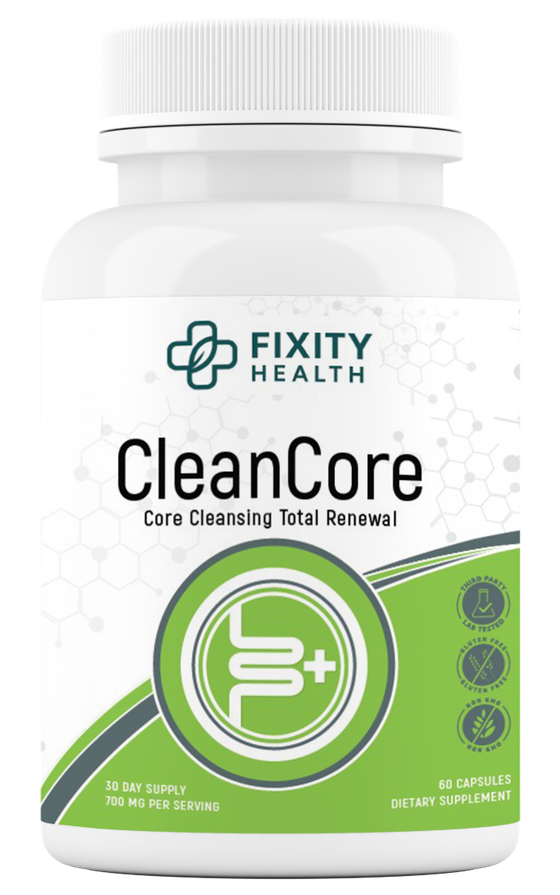

Ingredient One — Pharmaceutical-Grade Psyllium Husk: THE SCRUBBER
This is the heart of the whole thing. And here's the thing most people don't know about psyllium —
- The ONLY fiber that physically travels the entire five-foot colon intact. Every OTHER fiber — inulin, wheat dextrin, oat bran, the stuff in your breakfast cereal — either dissolves, or gets eaten by bacteria in the first foot of the colon, or ferments into gas. Psyllium is the one fiber that forms a thick gel AND doesn't get fermented, so it scrubs all five feet like a viscous snake. That's a direct quote from the Nutrition Today 2021 paper by McRorie and Fahey:"the psyllium gel transits the entire gastrointestinal tract intact." I underlined that sentence when I read it.
- Two hundred fifty-six peer-reviewed studies cited in the International Journal of Molecular Sciences document psyllium's microbiota benefits. This isn't alternative medicine. It's the single most-studied fiber on Earth.
- Why Dr. Delgado insisted on pharmaceutical grade — not the grocery store stuff. The grade matters. Pharmaceutical grade is what's prescribed in hospital settings and runs $15 to $25 a month at retail — if you can even find it. The cheaper stuff is cut with flavorings, sweeteners, and fillers that the FDA allows in food-grade psyllium because nobody thought to ask "what happens when the powder is the mechanism?" We asked.
- The "grease scrubber" analogy Ray would love. If Ray pushed a steel snake through your kitchen pipe, this is the supplement equivalent — except it's gentle, bulks up with water, and scrubs on the way through without damaging the walls.
Ingredient Two — Senna: THE SPARKPLUG
Here's where Dr. Delgado got firm with me. He said, "Look, Mark. Senna gets a bad rap because people abuse it. They take it alone, every day, in big doses, like it's candy. That's where the old 'cathartic colon' stories came from. That's dumb. That's not what hospital GI docs do."
Then he said: "Hospital gastroenterologists have been combining senna with psyllium for decades. Senokot-S is senna plus a stool softener. It's standard of care. Because the two together do what neither does alone."
- The 1987 Ewe study and the Marlett research (American Journal of Gastroenterology) compared psyllium alone to psyllium + senna. Psyllium + senna got significantly better laxation than psyllium alone. The combination is what hospital GI protocols have used for decades.
- Same research showed psyllium alone did NOT increase stool moisture. Psyllium + senna did. Which means fiber alone is literally half a solution.
- The pulse-dose is the secret. Dr. Delgado and I worked out a specific, measured, low-pulse dose — not a massive whack, but the exact amount studies show wakes peristalsis up without causing cramping or dependency. We tested it at three different levels in the lab. We landed on the one that made it feel gentle.
- Translation: Fiber is the mop. Senna is the light switch that tells the muscles "wake up and push the mop." You need both.
Ingredient Three — Goldenseal (Berberine): THE PATCH KIT
Here's the ingredient that solves the problem nobody else even tries to solve.
Remember when I said bacterial toxins leak through your gut wall into your bloodstream? You can scrape the pipe all day, but if the wall of the pipe is full of holes, toxins are still leaking out while you're scraping.
- Berberine literally "promotes the expression of tight junction proteins — ZO-1 and occludin — that seal the gaps between your intestinal cells." That's a direct quote from PMC10734964, the peer-reviewed paper I pulled up the afternoon Dr. Delgado explained this to me.
- It patches the holes in your gut wall WHILE the psyllium is scraping and the senna is pushing. So the junk you're loosening doesn't leak out on the way to the exit. Nobody else does this.
- It's the reason Dr. Delgado's formula doesn't just "clean you out" — it also heals what the old sludge damaged over the years.
- No other colon supplement on the market we could find includes a gut-wall repair ingredient. They all assume the pipe walls are fine. They're not. This is the big miss of the entire colon health industry. We checked. Our research team built a spreadsheet of 43 competing products. Zero included a tight-junction repair compound at therapeutic dose.
Ingredient Four — Ginger: THE TRAFFIC COP IN A CARHARTT VEST
Picture a guy in a Carhartt vest standing in the middle of a four-way intersection waving cars through. Calm. Steady. Nobody honking. That's what ginger does inside the pipe. It's not a scrubber, it's not a sparkplug, it's not a patch — it's the guy making sure the whole crew is moving in the same direction without anybody crashing.
- Wu et al, 2008 — ginger cuts the time food sits in your stomach by about a quarter. Sixteen minutes down to twelve. Which is a fancy way of saying the brick-in-the-stomach feeling after dinner stops being a thing.
- It nudges the small intestine to push instead of clench. Two thousand years of grandmas used it for upset stomachs before the double-blind trials caught up. Turns out the grandmas were right.
- It cancels the "I shouldn't have taken this" queasy. Most cleanses make you feel like you swallowed a spinning ride at the county fair. Ginger blocks that signal at the receptor before it ever reaches your stomach.
Ray would point at this one and say "that's the guy keeping the line moving." That's exactly what it is.
Ingredient Five — Fennel: THE THANKSGIVING-BALLOON KILLER
Here's the dirty secret about cleanses nobody puts on the box. Most of them make you walk around feeling like the over-stuffed uncle at Thanksgiving — pants unbuttoned, belly distended, gas you can't quite admit to. The whole "cleanse experience" is the kind of two weeks you don't book a beach trip during.
Fennel is the reason Clean Core doesn't put you there.
- Anethole — the active oil in fennel — physically tells the smooth muscle of your gut to unclench. No spasms. No tight cramping. The pipe stays loose while everything else does its job.
- A published trial on colicky infants — the worst gut criers on the planet — knocked symptoms down 65% versus 24% on placebo. If it can settle a screaming three-month-old, it can settle a fifty-eight-year-old.
- In adults, fennel paired with curcumin moved the needle on IBS symptoms in a peer-reviewed trial.
Plain English: fennel is why you don't walk around the office feeling inflated while the formula works. You take the dose, the rest of the crew does its job, and your belt stays where it was when you put it on. That's the whole point.
Ingredient Six — NAC (N-Acetyl Cysteine): THE HAZMAT SUIT
Now here's the one Dr. Delgado is proudest of. And this is where almost every colon product on the market drops the ball.
When you start breaking loose years of impacted waste, a LOT of that material gets reabsorbed into your bloodstream on its way out. Your liver is the final filter. Your liver uses glutathione to process those toxins.
Here's the problem — and this is what nobody warns you about —
- Most adults over 40 are running chronically low on glutathione.
- NAC is the direct precursor to glutathione. It's literally what hospitals use as the antidote for acetaminophen overdose, because it restores the liver's glutathione pool so the liver can process the toxin without dying.
- Including NAC in Clean Core is the difference between "I feel great after three days" and "I feel like I have the flu because my liver can't process what we just loosened up." This is the "detox flu" every cleanse on the market warns you about — and it's entirely preventable with adequate NAC.
- It's the hazmat suit. It's why Dr. Delgado's mother doesn't get the three-day misery most cleanses put people through. She gets the lift, not the flu. That's the NAC doing its job quietly behind the other five ingredients.
What Happens When You Actually Take This Stuff
Here's what Dr. Delgado told me to expect, here's what happened to me, and here's what his mother and early Fixity Health customers have reported back over the last six months.
First three days: You'll notice you're going more easily. Not dramatically — easily. No urgency. No cramping. Just… easier. Less straining. Your stool will look different — softer, more formed, more complete. You'll probably think "huh, that's not nothing."
First two weeks: The bloat goes down. Noticeably. My pants weren't tight across the middle. I didn't feel "full" all the time after eating. The gas went away — which I honestly didn't realize was a daily event until it wasn't. The first time I sat down in an airplane seat and didn't have to unbutton my pants, I almost laughed out loud.
Weeks three and four: This is where the weird stuff starts. And by weird I mean good weird.
The 2 PM crash stops happening. You just… keep going. You're not reaching for the third cup of coffee. You're not wanting to nap at your desk. You don't have to mute the camera anymore.
The brain fog lifts. I'm not talking "I feel smarter." I'm talking: you go to get your keys, and you know where they are, and you don't stand there blinking. Small thing. Huge thing.
The silent calculation quiets down. You stop bracing for the staircase. You just walk up it, the way you did when you were 40. You stop making the deal with yourself about which laundry can wait. You start carrying the full basket again.
The morning mirror shows you the face you remember.
Month two and beyond: Dr. Delgado's mother, at 72, reports the deep ache in her knees backed off substantially. The puffiness in her face went down. Her skin — and she pointed this out, not Dr. Delgado — looks less gray. Her mood is steadier. She sleeps through the night.
That's the real measurement. Not the number on a scale. The mailbox she walks to without stopping twice. The menu she reads without tilting it toward the candle. The grandkids she picks up without faking it. The laundry basket she carries up in one trip.
The Phone Call I Got From Dr. Delgado's Daughter-In-Law

I want to stop and tell you about one specific thing that happened with Dr. Delgado's mother, because it's the moment that put a lump in my throat the size of a tennis ball, and I don't want to bury it inside a bullet list.
About six months after she'd been on the formula, Dr. Delgado's daughter-in-law called me. Not Dr. Delgado. The daughter-in-law. Her name doesn't matter for this story. What matters is what she said.
She said, "Mark, I have to tell you what happened on Saturday."
Saturday morning, the seventy-two-year-old had gotten in her own car, by herself, and driven to the Publix at the corner — a four-minute drive she had not made alone in three years. Three years. Her son had been driving her to the grocery store every Saturday since 2023, because somewhere in there she had quietly stopped trusting her hands on the wheel after dark, and then her hands on the wheel during the day, and then her hands on the wheel at all. She had never said it out loud. Not to her son. Not to her doctor. Not to her husband while he was alive. The keys had just slowly migrated from her purse to a hook by the door to a drawer in the kitchen.
The daughter-in-law told me the seventy-two-year-old came home from that Publix run, parked the car in the driveway, walked into the kitchen with a single bag of groceries in each hand, set them on the counter, and started crying. Not sad crying. The other kind.
She said to her daughter-in-law: "I bought my own bananas."
That's the sentence I want you to sit with for a second. "I bought my own bananas."
The daughter-in-law said it took her about ten seconds to understand what she'd just been told. And then she said she sat down at the kitchen table and cried with her.
That's the kind of result I'm trying to make available to people. Not "lose ten pounds." Not "feel less bloated." "I bought my own bananas."
That's the measurement nobody's tracking, and that's the measurement that matters.
Here's What A Few Of Fixity Health's Earliest Clean Core Customers Said

"I'm 61. Retired HVAC contractor. I've been on fiber pills for 9 years — generic psyllium, the cheap stuff from the warehouse store. Tried Clean Core because my sister wouldn't shut up about it. Day 4, my wife asked if I got new glasses because my eyes 'looked clearer.' I hadn't. By week 3 I was down to the next belt hole. By week 6 I was sleeping without needing to get up at 3 AM to pee. I don't know what's in this stuff and I don't care. I'm buying it as long as it keeps showing up."
— Gary R., 61, Mesa, AZ

"I'm 67, retired high school English teacher, 34 years in the classroom. I told my doctor for three years I felt 'foggy.' He ran tests — thyroid, A1C, B12. Nothing. Four weeks on Clean Core and I started doing the Sunday crossword in ink again — something I hadn't done since I was 55. My husband said, 'Where have you been?' I said, 'I don't know, but I'm back.' My afternoon cup of coffee? I don't need it anymore."
— Linda M., 67, Sarasota, FL

"58. Cattle rancher. Not a guy who buys supplements. My daughter made me try it after I complained one too many times about my gut hanging over my belt. Three weeks in, the bloat that made me look pregnant at the end of a work day was gone. Energy back at 2 in the afternoon instead of face-planting in the truck cab between pastures. This stuff is the real deal and I don't say that about anything that comes in a bottle."
— Tom K., 58, Billings, MT

"I'm 63. I was on PEG 3350 every day for four years because my GP said it was 'safe for daily use.' I still felt like hell. Foggy, bloated, achy. I tried Clean Core in January. By the end of February I stopped the PEG. Not because I was told to — because I didn't need it anymore. My sister-in-law asked what I was doing different. I told her and she ordered it the same night. We compare notes every Sunday on the phone. She's 14 days ahead of me. She's off her acid blocker now too."
— Carol V., 63, Prescott, AZ
None of these are miracle claims. This is what happens when you unclog the pipe that, per Dr. Pizzorno, is generating a third of the small molecules in your blood.
You're not a different person. You're just YOU, minus the toxic load you've been carrying around for twenty years blaming on aging.