
The 67-Year-Old Phoenix Grandmother Whose Husband Says He "Just Married Her All Over Again"… And The 97-Cent Morning Ritual Her Dermatologist Doesn't Want Her Talking About
She paid $2,800 for a Botox quote she never signed. Eight weeks later, the woman in her bathroom mirror at 5:48 a.m. wasn't the woman she'd been mourning for ten years — and the German clinical trial behind it has 114 women, double-blind data, and one number the $67 billion "anti-aging" complex hopes you never see.

Listen.
I want to tell you about a 67-year-old grandmother in Phoenix named Margaret, and what she said happened the morning of her husband's birthday — about eight weeks after she opened a bottle of capsules my team at Fixity Health sent her.
She was standing in front of her bathroom mirror.
It was 5:48 in the morning. The overhead light was on — the cruel one, the one most women over 50 have stopped looking into because the shadows in that light tell the truth about your face in a way no Instagram filter ever will. Her hands were on the edge of the counter. Her husband was still asleep down the hall.
And here's what she told me, word for word, in an email I still have on my laptop:
"Mark, I was looking at the woman in the mirror, and for the first time in maybe ten years I thought — there she is. There's the woman I've been looking for. I started crying. Not the bad kind. The other kind."
Now here's why I'm telling you about Margaret.
Three months before that morning, she had a $2,800 quote in her purse from an aesthetician in Scottsdale. Botox in three places. A little filler under the eyes. A "starter package," they called it — and the woman behind the counter was very nice, and the office smelled like eucalyptus, and Margaret sat there nodding and saying yes, and then she got home and put the quote on her dresser and didn't sign it.
Not because of the money. (She has the money.)
Because somewhere in the back of her head a quieter voice was asking: And then what? In 90 days when it wears off — then what?
That quieter voice — the one that knows the medspa is selling a 90-day mask, not a fix — is the one I want to talk to today.
Because there's something the dermatologist who wrote your last retinol script didn't tell you. Something the woman who quoted you for filler doesn't bring up. Something the $400-a-jar face cream company would lose its entire business model over if it ever ended up on the front of a magazine.
Your body stopped making a specific protein at age 40.
Your skin was built out of that protein. Your hair root was built out of that protein. The cushion under your eyes was built out of that protein. And starting somewhere in your 40th year — earlier if you went through menopause hard — your body just… stopped. Not slowed down. Stopped. By the time most women hit 50, they've lost about 30% of it. By 65, it's worse.
Topical creams cannot fix this. I'm going to prove that to you in a minute with a number — one number, in something called kilodaltons — that will end the face cream industry for you in about 90 seconds.
So pour something. Settle in. By the time you're done reading, you'll know more about why your face has been changing than any dermatologist has ever bothered to explain to you.
Let me show you what I showed Margaret.
Quick word about who I am, since you're reading my letter and I haven't said. My name is Mark Edwards. I run a small supplement company in Orlando, Florida called Fixity Health. We started in 2006. Three products — one for the eyes, one for the gut, and the one I'm writing you about today, the one we're best known for. It's called Flex Force 5x. I'm not a doctor. Not a researcher. Not a chemist. I'm the guy whose name is on the bottle. I have a small team of actual researchers — chemists and product development people — who do the work, bring me the studies, argue with me about labels. I make the calls about what we sell. If something I tell you in the next few thousand words is wrong, the right place to send the angry email is to me.
What Happened To The Woman In The Photograph

Pull up a photograph of yourself from ten years ago.
Go on. Phone, drawer, picture frame, doesn't matter. Find one. I'll wait.
Now — look at her.
Look at the eyes. Look at the corner of the mouth. Look at the line of the jaw where it meets the neck. Look at how the cheek catches the light. Look at the hand resting on the back of a chair, or holding a glass, or curled around a child.
That woman is not gone, by the way. I want to be clear about that before I go any further. She is not gone. She's not dead. She's not a memory. She is, biologically, you. The cells in her eyes are the cells in your eyes. The bones under her face are the bones under your face.
What changed is not her.
What changed is one specific protein her body was making in industrial quantities — and yours stopped making, somewhere around your 40th birthday, on a clock you didn't set.
Not most of it. Not "produces less of it." Stopped.
That protein is called collagen. You've heard the word. Everybody's heard the word. It's been on the front of every magazine for a decade, and it's been turned into a marketing punchline by the same industry I'm about to spend the next few thousand words tearing apart for you, so I want to take it back from them right now and tell you what it actually is:
Collagen is the structural protein your face is made out of.
I mean that literally. About 75% of your skin, by dry weight, is collagen. Your skin doesn't contain collagen — your skin is collagen, with some other stuff (water, elastin, hyaluronic acid) packed around the collagen scaffolding. Same with your hair follicle. Same with the connective tissue under your eye. Same with the soft pad of cartilage in your knee. Same with the lining of your blood vessels.
When you were 25, your body was producing collagen the way a healthy bakery produces bread — constant, fresh, cleaning out the old, putting out the new. Your face wasn't smooth because of luck. It was smooth because the bakery was running.
Around age 40, the bakery starts laying off workers. Around age 50 — earlier for a lot of women, especially if you went through menopause hard — the bakery essentially closes. Production drops to a trickle.
Now here's where it gets weird. Because explaining this would make a four-minute dermatologist appointment look like the joke that it is.
When the bakery closes, you don't just stop making new collagen.
You also keep losing the old. Every day, your body is breaking down the collagen scaffolding it already has — that's normal, that's how skin renews itself. But for the first time in your life, the demolition crew is working without a construction crew behind it.
Demolition without construction is what aging looks like in the mirror.
It's the corner of the eye where the skin used to bounce back and now it folds. It's the line above the lip that wasn't there last Christmas. It's the slight hollowing under the cheekbone. It's the part of your hair widening. It's the upper eyelid that used to lift and now sits.
It's not gravity. (Gravity has always been there. Gravity didn't start working harder when you turned 50.)
It's not "stress." (You had more stress in your 30s than you have now.)
It's not "you didn't sleep well." (You slept fine in your 40s. Your face was different in your 40s.)
It's the bakery being closed. That's it. That's the whole thing.
And the reason I'm spending this much time on it is because once you actually understand it — once you sit with it for thirty seconds — every other "anti-aging" solution you've been sold for the last twenty years stops making sense at the same time.
I'll show you what I mean.
The $67 Billion Industry That Has To Pretend This Isn't True
This is going to make me unpopular at the next industry trade show, but here goes.
The "anti-aging" industry is not, in any meaningful way, an industry that fights aging.
It is an industry that masks aging.
Now, those two words look similar. They are not. They are completely different things, and the difference between them is the reason a 65-year-old woman in Texas can spend $1,800 a year on La Mer Crème de la Mer and SkinCeuticals C E Ferulic and a Vitamin A "skincare regimen" — and at the end of the year, the bakery is still closed.
Let me give you the rough numbers, just so you can see what you're really up against.
The global anti-aging market is roughly $67 billion a year. The largest piece of that — by far — is topical cosmetics. Creams, serums, eye treatments, masks. The next slice is professional aesthetic treatments: Botox, dermal fillers, lasers, peels, microneedling. The next slice after that is plastic surgery — facelifts, brow lifts, blepharoplasty.
Every single one of those approaches has one thing in common.
None of them turn the bakery back on.
Read that again. None of them turn the bakery back on.
That's not me being snarky. That's the actual mechanism. Botox doesn't make collagen. Filler doesn't make collagen. Retinol doesn't make collagen — it accelerates skin turnover, which is a different thing, and which is why retinol thins skin in some women instead of plumping it. La Mer's $380 jar doesn't make collagen. None of them do.
What they do — every one of them — is mask the appearance of the closed bakery for some period of time, and then the appearance comes back, and then you write another check.
Botox: roughly 90 days. $400 to $700 a session, three to four sessions a year, $1,600 to $2,800 a year, every year, for the rest of your life that you want to keep doing it.
Fillers: 6 to 12 months. $600 to $1,200 a syringe, often two or three syringes per session. Same math. Forever.
Facelift: 7 to 10 years, theoretically. $10,000 to $30,000. Six-week recovery. And — this is the part nobody explains — a facelift pulls and removes excess skin. It does not restore collagen. The hollow under the cheek is still hollow. It just gets covered.
PRP "vampire facial": $400 to $1,500 per session, multiple sessions, modest results, fades.
The "Hollywood stem cell" treatments you read about in magazines: $100,000 and up, and the data on whether they actually do anything is, charitably, soft.
I'm not saying these things don't work at all. Some of them produce a visible short-term change. I'm saying they don't fix what's wrong. They paint the door of a building where the bakery has closed.
And here's the part that should make you angry, if you're not already: the people selling these things know.
The dermatologist knows. The aesthetician at the medspa knows. The plastic surgeon's office manager knows. They know that what's happening to your face is collagen. They know that none of the things they're selling you make new collagen. They have to know — they went to school for this stuff.
So why don't they ever sit you down and say it?
I'll give you the honest answer. Because the conversation that ends with "your body stopped making a structural protein, and the only real fix is to give your body the building blocks to make it again" doesn't end at the cash register.
A four-minute dermatology appointment ends at the cash register. A retinol script and a filler referral end at the cash register. A "starter package" with the eucalyptus smell and the "starts at $2,800" pamphlet ends at the cash register.
A grown-up explanation of what's actually happening inside your skin doesn't.
That's the whole game. Not malice. Just business model. And if you've ever walked out of a medspa with a quote in your purse and a small voice in the back of your head asking but is this actually going to fix anything — that voice was right.
Margaret's voice was right.
Now, About The Refrigerator On The Porch
Okay. I'm going to make you a promise here, and then I'm going to deliver on it in two paragraphs.
The promise is this: by the time you finish the next two paragraphs, you will understand exactly why every face cream you've ever bought — every one — could not possibly do what its label promised. Not "doesn't work very well." Could not. Mechanically impossible.
Once you see it, you cannot unsee it. And once you cannot unsee it, you'll be done with topical creams forever, and you'll save yourself, conservatively, somewhere between $4,000 and $25,000 over the rest of your life.
Here's the picture I want you to hold in your head.
Imagine I drive a refrigerator-sized appliance up to your front door. White, big, heavy, twice the height of a person. And I leave it on your front porch. And the deal is, I tell you the appliance is for your kitchen — and then I just leave.
Now here's the question: how much of that appliance ends up in your kitchen?
Right. None. Because it cannot fit through the door.
It doesn't matter how many times I drive a refrigerator up to your front porch. It doesn't matter how expensive the refrigerator is. It doesn't matter what brand is on the side, or what fancy French phrase the marketing department came up with, or whether it cost $40 at Target or $2,950 at Bergdorf. The refrigerator cannot enter the door. The refrigerator does not fit.
That's the entire face cream industry, in one image.
Here's the science. The scientific unit for measuring the size of a molecule is called a dalton — a kilodalton is a thousand daltons. A normal collagen molecule, the kind that exists in a face cream, is somewhere around 300,000 daltons. The barrier of your skin — the layer that keeps water out and germs out and everything else out — has openings that are, charitably, around 500 daltons wide.
Read that again.
The molecule is 300,000. The door is 500.
That's a refrigerator on the front porch.
A 300,000-dalton collagen molecule does not penetrate the skin barrier. It cannot. It is mechanically, physically, biologically impossible for it to enter the layer of your skin where collagen is built. It sits on the surface. The marketing department of every face cream company on Earth has known this since roughly 1985, and the only thing that has changed since then is the size of their marketing budget.
Now I want you to think about what this means.
It means every La Mer jar you've ever cracked the seal on — the $380 ones, the $2,950 ones, doesn't matter — sat on your skin like a refrigerator on a porch. It means every $182 SkinCeuticals C E Ferulic bottle did the same. It means every "collagen-boosting" eye cream and night cream and serum and "treatment essence" did the same. The molecules cannot enter the door. They never could. They never will.
And the people selling them know.
The chemists at La Mer know. The chemists at SkinCeuticals know. The chemists at every major brand know. This is freshman-level chemistry. This is the kilodalton story, and it has been sitting in the textbook the whole time, and the only reason you haven't heard it before is because nobody who profits from your purchase wants to be the one to explain it to you.
I told you the refrigerator picture wasn't going to leave your head. I'm sorry. There's no kind way to say this.
You've been buying refrigerators and putting them on the porch for thirty years.
Okay. Take a breath. The next part is the good news.
Why Eating Collagen Is A Completely Different Story
I'm going to anticipate your next question, because it's the one I had when my team first showed me this. I pushed back hard the first time. I was sitting in my office in Orlando and my chief researcher slid a pile of journal articles across my desk and said: we need to look at this. And I read the first three pages and said something like come on, this is a coffee creamer scam, we're not doing collagen, and she sat there and waited me out.
Here's what she made me understand.
If a 300,000-dalton molecule can't get through the skin barrier from the outside, it sure as hell can't get from your stomach into your bloodstream from the inside. So if you eat a normal piece of collagen — bone broth, basically, the way our grandmothers made it — most of it does nothing for your skin. Some of it gets broken down into amino acids that your body uses for general repair, but that's it. The collagen molecule itself never reaches the dermal layer where the bakery used to be.
Which is why the first wave of "beauty collagen" tubs — the ones you see on Amazon, the Vital Proteins, the NeoCell, the Sports Research, the Garden of Life — never quite delivered on their hype. Women bought them, scooped them into coffee, did it for three months, looked in the mirror, didn't see anything, and quietly stopped.
(I'm not picking a fight with those companies. I just want you to know why their products mostly don't move the needle. It's not that they're scams. It's that they're solving the right idea with the wrong molecule.)
Here's what changed.
Sometime in the early 2000s, a couple of European labs — German and Danish, mostly — figured out a process called enzymatic hydrolysis. It's a cold-process method — no heat damage — where specific enzymes are used to clip a normal collagen molecule into very small pieces, the way you might cut a 200-foot rope into one-inch sections.
When you cut it small enough, two things happen.
The first thing — and this is the obvious one — is that the pieces are now small enough to enter the bloodstream. We're talking pieces under 500 daltons. Below the threshold. They cross the gut wall. They circulate. They reach the dermis.
The second thing — and this is the part that surprised the researchers, and frankly the part that made me sit up in my chair — is that some of the small pieces are not just building blocks. They're signaling molecules.
Specifically, two little fragments named Pro-Hyp and Hyp-Gly. (I'm sparing you the chemistry, but if you want the molecular names, they're proline-hydroxyproline and hydroxyproline-glycine.) When these fragments reach your dermal layer, they don't just sit there waiting to be made into collagen. They actually tell the cells — the fibroblasts, the cells that build collagen — to start working again.
Read that again.
The fragments don't just provide raw material. They reopen the bakery.
Now I want to be careful here, because this is where supplement companies get carried away and start sounding like infomercial pitchmen. So let me say it the careful way. The peer-reviewed research on hydrolyzed collagen peptides shows two things consistently across multiple studies: (1) the small peptides do reach the dermis, and (2) the dermis responds by upregulating fibroblast activity, which is the technical way of saying the bakery starts running again.
The result, in a series of double-blind, placebo-controlled trials, has been measurable changes in skin elasticity, eye-area wrinkle volume, hair grading and nail breakage — across populations of women who took collagen peptides daily for 8 to 12 weeks.
Let me show you those trials. Because this is the part where we stop talking theory and start looking at numbers.
What 114 German Women Found Out In 8 Weeks

The headline study — the one I want you to remember if you remember nothing else from this letter — was published in 2014 in a journal called Skin Pharmacology and Physiology. The lead author is a researcher named Proksch, working out of the University of Kiel in Germany. (Kiel is a real university. Skin Pharmacology and Physiology is a real, peer-reviewed journal. You can pull this study up on PubMed in about 15 seconds — I'll wait if you want to.)
Here's how the study worked.
114 women, ages 35 to 55. Double-blind, placebo-controlled. Half got a daily dose of hydrolyzed collagen peptides. Half got a matched placebo (something inert that looked and tasted the same). Eight weeks. Nobody — not the women, not the researchers handing out the doses — knew which group was which until the data was unblinded at the end. That's the gold-standard format for clinical research.
Translation break, because I'm not going to leave you swimming in jargon: this means the result couldn't be explained by wishful thinking or the women trying harder because they thought they were getting the "real" stuff. The placebo group also thought they were getting the real stuff. They couldn't tell.
Here's what the data showed at week 8.
The collagen group showed an average 20% reduction in eye-area wrinkle volume. The top responders in the group hit 49.9%.
Now I want to be careful about that second number, because it'd be dishonest of me to dangle it in front of you without a friction beat. The 49.9% is the top responder — the deepest individual responder in the trial. Not the typical result. Not the promise. The average woman in the collagen group hit 20%. The 49.9% is what the bakery is capable of in the most responsive bodies. Don't read that number as "I'll lose half my wrinkles in eight weeks." Read it as: in eight weeks, on a daily oral capsule, in 114 women, the bakery measurably reopened — and in some women, it threw the doors open. That's the honest read.
The collagen group also showed a 65% increase in pro-collagen Type I production in the dermis. Translation: the bakery, in the middle of your face, the one that's been closed for fifteen years, was running. Measurably. In a peer-reviewed clinical trial.
Now I want to pause here and say — because I'd be a dishonest man not to — this trial was on women using hydrolyzed collagen peptides. Not on Flex Force 5x specifically. The Kiel trial used a peptide complex very similar to the foundation of what we put in our capsule, but I'm not going to tell you Mark Edwards' product was tested on 114 German women, because that would be a lie. What I'm telling you is that the category of ingredient — small-peptide hydrolyzed collagen — has the data to back the mechanism.
What we've added on top of that — the part that's specific to Flex Force 5x — is what I want to walk you through next.
But before I do, let me show you two more studies.
The 2024 Trial. The Menopause Cliff. And A Number About Your Fingernails.

The second study I want you to know about was published this year — 2024 — in a journal called Dermatology Research and Practice.
130 participants. 12 weeks. Double-blind. Same format as Kiel.
The headline numbers from that one:
- 22.7% improvement in skin elasticity (measured with a calibrated probe, not by asking the women).
- 31.9% improvement in hair grading (measured by trained graders looking at standardized photos, not by asking the women).
Both of those numbers came in at high statistical significance. The trial was clean. It replicated, in 2024, on a larger sample, what the Kiel data showed in 2014. And it added the hair finding — which was something a lot of women in the trial said, in their post-trial debriefs, surprised them. They came in for the skin. They got the hair as a side effect.
The third study is older — 1987 — and it's the one I want you to read three times.
It was published in Obstetrics and Gynecology by a researcher named Brincat. It tracked collagen content in skin biopsies of post-menopausal women. The headline finding:
Women lose roughly 30% of their skin collagen in the first 5 years after menopause.
Thirty percent. In five years. In the first five years after menopause.
That's not aging. That's a building losing a third of its load-bearing wall in sixty months. And nobody told you it was happening.
Now look — if you're past menopause, you already know this on a level that doesn't need a journal article. You felt it. You felt the cliff. You woke up one year and your skin was different, and not in a way that could be undone with a better cream.
But here's why I want you to know the study exists. Because for the rest of your life, every time a dermatologist or an aesthetician quotes you for a treatment that doesn't address the underlying drop, I want you to be able to say to yourself: Brincat 1987. Thirty percent. The bakery closed.
That's not a fringe finding. That's been settled medical literature for almost forty years. The reason your dermatologist hasn't sat you down and walked you through it is not because she doesn't know. It's because her business model doesn't reward the conversation.
One more.
A study published in 2017 in the Journal of Cosmetic Dermatology, lead author Hexsel, looked at women who took collagen peptides for 24 weeks and tracked nail breakage. The headline number: 42% reduction in nail breakage at week 24.
I include that because if you've watched your nails go to hell over the last few years and started telling yourself you "just need to use cuticle oil," I want you to know it's not a hand-cream problem either. It's a bakery problem.
Translation break: skin, hair, and nails are made out of versions of the same family of structural proteins. They go down together. They come back up together. Margaret didn't write me about her nails. She wrote me about her face. But six weeks in, she mentioned, almost as a side note in a follow-up email, that she'd stopped breaking her nails for the first time in a decade. I didn't even put two and two together until last Tuesday, she wrote. I was filing one and I just looked at my hand and went — wait.
That's what I want you to remember. The bakery doesn't open in just one part of you. When it reopens, it reopens everywhere it was closed.
The Barn Raising With Only Bricks
Okay. Now I have to walk you into the part that separates Flex Force 5x from every Type-I-only beauty collagen tub on Amazon. Because if I don't, I'm not telling you the whole story.
Here's a picture.
Imagine you show up at a barn raising. Twenty neighbors there, sleeves rolled up, ready to put up a structure that has to stand for a hundred years. And someone hands you a pallet of bricks. Beautiful bricks. Perfect bricks. Top of the line. $400-a-pallet bricks.
That's it. Just bricks.
No mortar. No rebar. No timber. No foreman with the blueprint. No mason who knows what goes where. Just a pallet of bricks sitting in a field, and twenty neighbors looking at each other.
How much barn gets built that day?
That's a Type-I-only beauty collagen tub.
It is the right idea — give the construction crew building blocks. It is the wrong delivery — bricks alone don't make a wall. And the marketing department of every Type-I-only beauty collagen brand on Amazon will not, ever, sit you down and explain that to you. Because explaining it would make you put the tub back on the shelf.

Here's the actual chemistry.
Your body uses collagen in at least 28 different forms that we currently know of, but five of them carry the structural load on the parts of you that you can see and feel. They're called Type I, Type II, Type III, Type V, and Type X.
Each one builds something different.
- Type I — the big one. About 90% of your skin's collagen by weight. Also the main structural protein in your bones, tendons, ligaments. This is what most "beauty collagen" tubs sell. The pallet of bricks.
- Type II — your cartilage. The cushion in your knee. The disc in your back. About 85 to 90% of cartilage is Type II collagen. Almost no beauty collagen on the market includes it.
- Type III — works in tandem with Type I in your skin. They braid together. Type III is what gives young skin its bounce-back. Loss of Type III is one of the reasons skin gets that thinner, papery quality with age. Think of it as the rebar that keeps the bricks from cracking apart.
- Type V — the rarest of the five, but critical. Type V is the organizer — it controls the assembly of Type I and Type III fibers. It's the foreman on the construction site. Without Type V, the bricks pile up wrong.
- Type X — found in cartilage growth plates, joints, and bone repair. Important for the parts of you that take impact.
If you're 55 and your skin is the issue, you might be thinking — okay, I'll just take Type I, that's the skin one, why complicate it.
Here's why.
Your fibroblast — the cell that builds collagen — doesn't say I'd like Type I now, please. It uses a coordinated complex of types. Give it Type I in isolation and it's the barn raising again. Bricks. No mortar. No foreman. The wall doesn't go up.
Plus — and this is the part the Type-I-only companies will never tell you — the moment your knee starts hurting at age 60 because your cartilage is going, no amount of Type I in your morning coffee is going to do anything for that, because cartilage isn't made out of Type I. It's made out of Type II.
What we did at Fixity Health was build the complex around all five types, in the ratios the actual fibroblast uses. We call it the 5-Type Bakery Complex — not because it sounds good on a label, but because that is literally what it does: it hands your skin's construction crew the full set of materials, in the order they're used, so the bakery can actually run again. One brick type doesn't reopen a bakery. The complete set does.
We added one more thing. And it's the piece I want to spend an extra minute on.
The Chicken Sternum Problem (And Why We Cold-Process)

You can't really make a Type II collagen supplement that works the way Type II is supposed to work — I mean, really works, not "well, the label says Type II" — without dealing with one specific source problem.
Cartilage is hard. By design. It's the part of you that doesn't break down. So when you grind it up, you get powder, but the powder is a mess of broken protein. Most of the structural information is destroyed. You can swallow a tablespoon of it and your body looks at it and goes okay, here's some amino acids, thanks, and that's the end of it.
What we use is a specific source called undenatured Type II collagen, sometimes abbreviated UC-II, derived from chicken sternum, cold-processed.
Three things in that sentence matter.
Undenatured means the protein structure is intact. Not boiled, not crushed at high temperature, not chemically broken apart. Your body sees it whole, the way it would see actual cartilage. That matters because — and this is one of the more remarkable findings in joint research over the last decade — at very small doses (40 milligrams), undenatured Type II collagen interacts with a part of your gut wall called the Peyer's patches. The Peyer's patches are immune-system tissue. They essentially "read" the intact Type II collagen and tell the rest of your immune system to stop attacking your own cartilage.
That's not me being colorful. That's the mechanism. As you age, your immune system starts mistakenly degrading your own cartilage — it's part of why arthritis pain gets worse over time even when you "haven't done anything to it." UC-II at 40 mg, taken daily, retrains the immune system off that pattern.
Chicken sternum is the source because chicken sternum cartilage has the highest concentration and best-preserved Type II protein structure of any commonly available source.
Cold-processed is the part that costs us money and is the reason you don't see a lot of this on the market. Heat destroys the protein. So instead of high-temperature processing — which is faster and cheaper — we use a low-temperature enzymatic process that preserves the structure. It costs more. It's worth it.
There's a study from 2009 by a researcher named Crowley that compared UC-II head-to-head against the standard joint supplement glucosamine + chondroitin. (It was a small study — n=52 — so I want to be careful about how much I lean on it. Take this as suggestive, not as the centerpiece.) UC-II showed roughly 33% improvement on the WOMAC joint-pain index, versus 14% for the standard glucosamine/chondroitin combo. Same time period. Same population. About double the effect.
And — this is important, and it's why I'm making it a point to tell you, even though it dilutes my own marketing — we also include glucosamine and chondroitin. Plus hyaluronic acid. Because the data on combined formulations is stronger than any single ingredient alone.
The total daily dose, in three capsules a day, is 1,800 milligrams of the active complex.
Okay. That's the mechanism. Let me come back to people.
The Cameras-For-Six-Years Woman
I want to tell you another story.
This one is from a customer in Ohio. I'm going to call her Donna, because that's not her real name — she's a teacher, she was very specific that she didn't want her name on a sales letter, and frankly I respect that. (Inline pseudonym disclosure, in case you're keeping score. I don't pretend to use real names for people who don't want them used.)
Donna is 58. She wrote my team an email in late January.
She told us, in the email, that she had stopped letting people photograph her six years earlier.
I want you to sit with that.
Six years.
Not "I don't love photos of myself." Not "I delete the bad ones." She had, methodically, for six years, declined to be in pictures. At her son's college graduation, she stood behind the family. At her sister's birthday dinner, she took the photos but didn't appear in any. On every video call for work, the camera was off. At Christmas — and I'm quoting her email here — I'd say I was the one who'd been holding the wine glass, and I'd disappear into the kitchen.
Six years of not existing in photographs.
Then this past Christmas morning — Donna's daughter visited from out of state, and her daughter is 28 and doesn't ask, she just takes the picture. Donna was in the kitchen pouring coffee, hair pulled back, no makeup on, and her daughter snapped a photo and sent it to the family group chat.
Donna saw the photo.
She didn't recognize herself.
But — and here's what she said in her email — I didn't recognize myself in a good way.
I'll quote her, with permission to use the words but not the name:
"I had been on Flex Force for fourteen weeks. I'd noticed my hair, and I'd noticed that the line that runs from my nose down to the corner of my mouth wasn't as deep — I'd noticed it but I hadn't really let myself believe it. And then there was this picture. And it didn't look like the woman who hides from cameras. It looked like the woman from before. I sat at the kitchen table and didn't say anything for about twenty minutes."
She told us she's letting people take her picture again.
Now I want to say something here, because I don't ever want to be the guy who weaponizes a private moment to sell you a product.
What I'm telling you about Donna is not "if you take Flex Force you will reverse six years of avoidance in one Christmas morning." I don't know what Flex Force will do for you specifically. I don't know your skin, I don't know your menopause timeline, I don't know what else is going on with your hormones, I don't know whether you'll be one of the women who responds the way the top responders responded in the Kiel trial or whether you'll be one of the more average ones who get a quieter, slower change over a longer period of time.
What I'm telling you is that the bakery can reopen. That has been demonstrated in clinical trial after clinical trial. The mechanism is real. The science is real. And the customers — Donna, Margaret, Linda, the woman I'm about to tell you about who got asked about her older sister at her own mailbox — are not statistical noise. They are women whose bodies started making collagen again, and who can see the result in the mirror, and who wrote us about it because they couldn't quite believe it themselves.
Let me tell you about the mailman. Because this one I love.
"Is Your Older Sister Home?"

Margaret has a friend who I'll call Carol. (Inline disclosure: not her real name. She works in healthcare and didn't want to be identified by name, but she gave me permission to tell the story.)
Carol is 60. She lives in a quiet street in a Midwestern town I won't name for the same privacy reason. She's been on Flex Force for ten weeks at the time of this story.
A new mailman is filling in for the regular guy on her route — the regular guy is on vacation, the new kid is maybe 25, fresh-faced, polite. He has a package that needs a signature. He walks up the driveway holding the slip. Carol is at the mailbox in a sweatshirt and jeans, no makeup, hair pulled back.
The kid looks at her, smiles, and says: Hi, ma'am, is your older sister home? I have a package that needs a signature for her.
Carol doesn't have an older sister.
She is, in fact, the older sister of two younger brothers.
She told me later that she didn't correct the kid. She just said I'll sign for it, signed the slip, took the package back into the kitchen, set it on the counter, and stood there for a minute. Then she went and looked in the mirror over the sink — not to see herself, but to try to see what the kid had seen.
And then she sat down at her kitchen table and wrote my team an email, and the subject line was: I think this is working.
That email is on a printout in my office.
I tell you this story not because I want you to expect that exact moment. I tell you because the moment is real — it actually happened — and because of all the moments my team has heard about over the last few years, that one is the cleanest. A 25-year-old kid filling in on a route, no skin in the game, no flattery agenda, no reason to lie. Just a kid who looked at a 60-year-old woman and assumed she was the younger one.
That's not Botox. Botox doesn't make a 25-year-old mailman think you're 45. Botox makes a 25-year-old mailman think you've had Botox.
That's the bakery being open.
Now — Carol is one customer. She's a particularly good responder. There's noise in any one story. What I'll tell you is the noise has been adding up over the last few years, and the pattern in the noise has been pretty consistent: women who take this for 8 to 14 weeks tell us, in their own words, that something starts changing around week 6, and that it isn't subtle by week 10, and that other people — people who weren't expecting anything — start noticing.
That's the tell. When other people notice, it's not a story you're telling yourself in the mirror. It's the bakery being open.
What Margaret's Husband Said

I want to go back to Phoenix, because I owe you the rest of Margaret's morning.
I told you she stood at her bathroom mirror at 5:48 a.m. on her husband's birthday and thought there she is. What I didn't tell you is what happened forty minutes later, and it's the part she actually led her email with.
She was in the kitchen making his eggs. He came in, still half asleep, and he stopped in the doorway — just stopped — and he looked at her the way she said he used to look at her, a long time ago, before any of it. He didn't say you look younger. He didn't say did you do something. What he said, standing in the doorway in his robe on the morning of his own birthday, was: "I feel like I just married you all over again."
Margaret wrote me that she had to put the spatula down.
That's the line I want you to sit with. Not because it's flattery — her husband isn't a flatterer, she made a point of telling me that — but because of who said it. The man who has watched her face every single morning for decades. The one person on Earth who would never be fooled by a filter or a good angle or a flattering light. He's the hardest audience she has. And he's the one who said it.
That's what the bakery being open actually buys you. Not a stranger's compliment. The look you'd stopped expecting from the person who knows your face best.
What Other Women Wrote To My Inbox — In Their Own Words
Margaret S., 67, Phoenix — verified customer: "I was looking at the woman in the mirror, and for the first time in maybe ten years I thought — there she is. There's the woman I've been looking for. I started crying. Not the bad kind. The other kind." (Margaret started Flex Force originally for joint pain. The skin and hair changes were a surprise. We've kept her testimonial on the Fixity Health site for almost two years now.)
Linda A., 68 — verified customer: "My knees were bad enough that I had a consultation in my purse for a replacement. I haven't scheduled it. I'm not saying I won't ever — but right now I'm doing things I didn't think I'd do at 68, and I'm not the woman who used to dread the stairs." (Linda's story is about joints, not skin, but I include her because the same protein runs both.)
Petru Sincraian, 62 — verified customer (table tennis): "The first three weeks I didn't notice anything. Week four I realized I'd played for an hour and didn't ice afterward. I haven't iced since. I'm 62, I beat people half my age at this club, and I don't know what to tell them when they ask me what I'm doing differently."
Dr. Bill Trusak, D.C. — practicing chiropractor, 28 years, sees roughly 200 patients a day: "I'd rather have my patients on something that gives them the actual building blocks than another anti-inflammatory that just masks pain. I take it myself."
Dr. J. Gastineau — medical professional working 12-hour hospital shifts: "Anybody who's done back-to-back 12s knows what that does to your knees. I noticed the difference within a few weeks."
"Karen" — inline-disclosed pseudonym, 64, a customer in Florida — wrote about her hair: "The drain in the shower used to scare me. Every morning, more in there. Around week 9 I realized the drain was clean and I hadn't noticed when it stopped."
"Ellen" — inline-disclosed pseudonym, 71, customer who originally bought it for her husband — wrote at week 12: "I've started buying it for me. He's still on it. But I'm the one telling people now."
Translation break, before I move on: I'm not lining these up to be impressive. I'm lining them up because if you read the same kind of email two hundred times — at different ages, different starting points, different reasons for trying it, different parts of the country — what you stop being able to do is dismiss them as anomalies.
What I Couldn't Fit Into The Letter (But You Should Know)
Before I get to the offer, I owe you a few more things. The Age-Reversal Accelerator that comes with the Never-Run-Out plan is a 40-something-page guide built around one question my team kept asking: what do the top responders in our customer base all have in common? It's not 800 pages. It's not pretending to be a book. It's the working notes from reading every customer email for two years, boiled down to the four daily habits that separate the women who get a big result from the women who get a quiet one.
Here are some of the things you'll find inside it — the lines I had to leave out of this letter for length:
-
The four daily habits the top responders share — what they eat for breakfast, when they stop drinking water, how they sleep, and the specific 90 seconds at night that does the most for skin recovery. None of it costs a dime. None of it is a product. It is the difference between the top quartile of responders and the average.
-
The "5:48 AM mirror habit" — it takes 90 seconds, it has nothing to do with the capsule, and the deepest responders all do it. (Don't worry — it's not a yoga pose.)
-
The one-question test for any face cream still sitting in your bathroom drawer. It's a chemistry question, and the answer's printed on the side of the jar in numbers you've never been told to look at. Once you know the number, the drawer goes in the trash.
-
Why "drinking more water" is the second worst piece of skin advice ever given to a 50-year-old woman… and what to drink instead, in what order, in the ninety minutes after you wake up.
-
The four-minute dermatologist appointment — why it's the worst place on Earth to ask about your face, and the seven words that, if you say them at the next visit, tell you everything you need to know about whether to keep going to her.
-
The "$2,800 dresser test" — a 30-second exercise for any woman with an unsigned medspa quote sitting in a drawer right now. Do it tonight. It's free. It takes one breath and one piece of paper.
-
The 49.9% question. Why some women in the Kiel trial cut their wrinkle volume nearly in half while others held at 12% — and what the data says, quietly, in the supplementary tables, about which women landed where.
That's what's in the Accelerator. You get it free with the Never-Run-Out plan.
Okay. Now let me show you the offer.
The Conversation You Won't Have At The Medspa
I want to come back to the medspa for a minute, because I never properly closed the loop on the $2,800 quote that started Margaret's story.
Here's what I think — and I'll caveat this as my opinion, not as medicine, because I'm not a doctor.
If you went into a medspa tomorrow and you said I'm here because my face has been changing for the last five years and I want to know what's actually causing it, I think you would not get an answer. You'd get a recommendation. The recommendation would involve Botox in a specific number of units, possibly some filler, possibly a series of microneedling treatments, possibly a "skincare regimen" with three or four products. It would total somewhere between $1,800 and $4,500 for the first appointment.
What you would not get is a conversation about Brincat 1987 and the menopause cliff. You would not get a conversation about the kilodalton problem. You would not get a sit-down explanation of why the bakery closed at 40 and what it would take to turn it back on.
That conversation is not in the script.
I want you to notice, for a second, that this isn't because the people working there are stupid or evil. The aesthetician at the medspa is, in most cases, a competent professional doing her job. The dermatologist is, in most cases, a smart person who went to medical school. The owner of the practice is running a business with a lot of fixed costs.
The conversation just isn't in the script.
Their script ends at your treatment plan starts at $2,800, would you like to schedule your first session today.
My script — and I want to be transparent that I have a script, because you are reading my sales letter — ends at your skin was built out of a protein your body stopped making, and there is a clinical trial showing the protein can be replaced through a small-peptide oral capsule, and we make one for $39 a month.
You can decide which script is more useful to you. I'm not asking you to take my word for any of this. I'm asking you to look up Proksch 2014 in Skin Pharmacology and Physiology. Look up Brincat 1987 in Obstetrics and Gynecology. Look up the 2024 Dermatology Research and Practice study. Look up Hexsel 2017 in the Journal of Cosmetic Dermatology. These are real journals with real peer review and real DOIs you can search in five minutes.
When you've looked them up, come back, and I'll tell you exactly what you'd be getting from us, exactly what it costs, and what we do if it doesn't work.
Okay. So What Is Flex Force 5x.
Let me lay it out plainly. No marketing fluff. Just what's in the bottle.
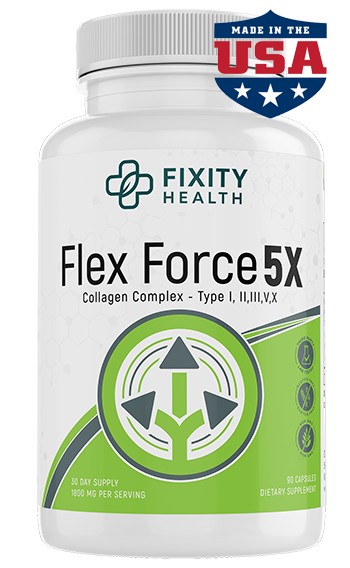
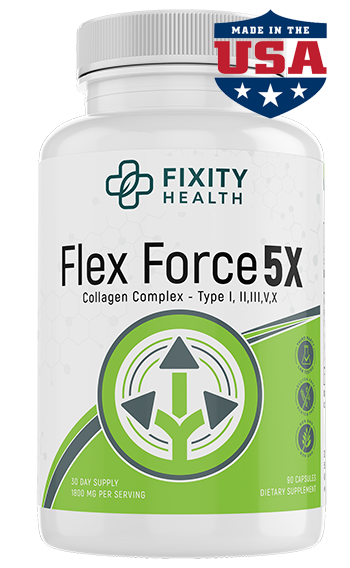
Flex Force 5x is a daily oral capsule. Three capsules a day. One bottle is 90 capsules — 30 days.
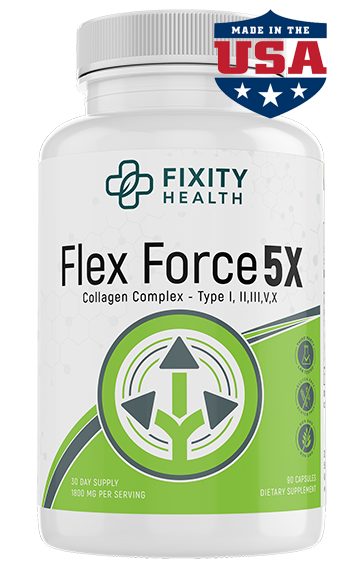
Active ingredients: - Hydrolyzed collagen peptides at the small-peptide size that crosses the gut wall and reaches the dermis (this is the working part — the bakery-reopener) - The 5-Type Bakery Complex — collagen Types I, II, III, V, X, the structural set your body actually uses - Undenatured Type II collagen (UC-II) from chicken sternum, cold-processed to preserve protein structure — works through the Peyer's patches mechanism for joint cartilage at 40 mg/day - Glucosamine — well-established joint support - Chondroitin — pairs with glucosamine for cartilage matrix support - Hyaluronic acid — skin moisture retention, joint lubrication
Total active complex: 1,800 mg per day (3 capsules).
Source standards: - Manufactured in Utah at an FDA-Registered, cGMP-Certified facility - Made in USA - Third-party tested for heavy metals, microbiology, and label accuracy
Who shouldn't take it: anyone with a chicken or fish allergy (collagen is sourced from chicken sternum and marine collagen). Pregnant or nursing women — talk to your doctor first. People on prescription anticoagulants or with serious chronic conditions — talk to your doctor first. This isn't medicine. It's food, in capsule form. But your doctor still knows you and I don't.
How long until you see something: - Week 4-6: most women report the first thing they notice is a quieter joint or a quieter back. (This isn't placebo — UC-II is doing its work in the gut wall.) - Week 6-8: the hair drain. Most consistent early skin tell. The amount of hair coming out in the shower drops. - Week 8-12: the corner of the eye. The line above the lip. The cheek that picks up the light again. - Week 12+: the moments. The compliments that stopped. The mailman. The Christmas photo.
That's the honest curve. Not three days. Not two weeks. Eight to twelve weeks before the bakery is fully open.
What This Costs (And Why It Costs So Little)
I'll get the ugly part out of the way. You're going to think the price is too low.
If I told you we charged $300 a month for this, you'd believe me. There are creams that cost more for less. There are aesthetic treatments that cost ten times this for results that fade in 90 days. The Hollywood "stem cell" treatments people whisper about cost as much as a car, and the data on whether they actually do anything is, charitably, weaker than the data on what we make.
Quick math, before I show you the offer. So you can see what's actually on the table.
| What you've been doing | What it costs | What you have to show for it in five years |
|---|---|---|
| Botox + filler (typical) | $1,600–$2,800/year, every year | $8,000–$14,000 spent. Bakery still closed. |
| Premium creams (La Mer, SkinCeuticals, etc.) | $1,200–$2,400/year, every year | $6,000–$12,000 spent. Refrigerator still on the porch. |
| Facelift | $10,000–$30,000, plus 6-week recovery | Excess skin removed. Hollow under cheek still hollow. |
| Flex Force 5x at $39/month | $468/year. $2,340 over five years. | The bakery measurably reopens at 8-12 weeks. Documented in 114-woman German trial. |
The reason Flex Force 5x is $39 a month on the Never-Run-Out plan, not $300, is because of how Fixity Health runs.
We don't sell in stores. We don't pay slotting fees to Walgreens. We don't run TV commercials. We don't pay celebrity endorsers. There is no Fixity Health office in midtown Manhattan with a glass desk and a receptionist.
We have a small office in Orlando, a manufacturing partner in Utah, a research team that argues with me about labels, and a customer service line you can actually get a person on. That's the whole company. The cost of getting a bottle from us to your kitchen counter is, mostly, the cost of the ingredients and the shipping. We don't have a $400-cream's marketing budget to recoup, so we don't price like one.
Here's the deal we put together for new readers of this letter.
Option 1 — Never-Run-Out Plan (recommended) - $39 per bottle, ships every 30 days - Free U.S. shipping - Includes the Age-Reversal Accelerator Protocol PDF, no charge - Pause or stop with one click — no phone call, no email, no "winback offer," nothing - $1.30 per day. Less than a postage stamp.
Option 2 — One bottle, one time - $49 for one bottle - 30-day supply - No reorder, no follow-up, you order it once and it shows up
Either way: - 60-day money-back guarantee. Full refund. Even if you've taken every capsule. We don't make you ship the empty bottle back. We don't ask you why. You email us, we refund you, that's it.

A word about the Never-Run-Out plan, because I want to be straight with you about it.
There's no contract. There's no minimum. There's no "lock-in for three months and then we'll let you cancel." It's a delivery convenience. The reason we built it that way is because the women who do best on Flex Force are the ones who don't run out — and we found, after running this for a couple of years, that the single biggest reason a Flex Force customer doesn't see results is that she ran out around week 6 and didn't reorder for a couple of weeks. The bakery doesn't like inconsistency.
If you go on the Never-Run-Out plan, your bottle shows up before you run out. That's it. If at any point you have enough or you're done or you want to stop, you click one button and it stops. We don't make you call. We don't make you write a letter. We don't make you justify it. We are not in the customer-handcuff business.
The Age-Reversal Accelerator PDF — that's something my team put together that goes with the capsule. It's not magic. It's a 40-something-page guide that walks through the four daily habits the top responders in our customer base have in common — what they eat for breakfast, when they stop drinking water, how they sleep, the specific 90 seconds at night that does the most for skin recovery. We give it to Never-Run-Out customers because if you're going to invest 8 to 12 weeks in this, we want you to be one of the top responders, not one of the average ones.
Now — three things you should know before you click anything.
One. The cold-process UC-II is the part of this formulation that costs us money and takes us time. We make Flex Force 5x in small cold-process batches in Utah — that's the slow, expensive, careful part of all this — and for the last stretch, demand off letters like this one has been running ahead of comfortable supply. When a batch sells through, new orders wait for the next one to finish curing. I can't tell you the next gap will happen on a particular day, because I genuinely don't know. What I can tell you is that the bottle in the warehouse today is the bottle you can have today. The one you're waiting on next month is a maybe.
Two. Every $39 you don't put toward this is a $39 vote for the dresser drawer where the $2,800 quote is sitting. The unsigned quote in the drawer doesn't expire. It also doesn't do anything. Eight months from now, the line above your lip will have deepened at the rate it's been deepening — that rate is real, it's measurable in studies, and it has been your rate for the last five years. The Never-Run-Out plan costs less than two large coffees a week. The dresser drawer is free, and it's costing you a face.
Three. I'd rather you spend the $39 and find out it's not for you and get refunded than spend the $2,800 at the medspa and pay it again every 90 days for the rest of your life. That's just an opinion, but it's mine, and I'm willing to put my company behind it with the 60-day guarantee.
The math, if it helps: $39 a month is what you'd spend on roughly two large coffees a week. $1.30 a day is what most people lose between the couch cushions in a month. The $2,800 you didn't sign for at the medspa would buy you almost eight years of Flex Force.
Look. Here's What I'd Do If I Were You.
I'm going to drop the salesman voice for a minute and talk to you the way I'd talk to my own friend at a kitchen table, because I think you've earned that.
If I were you — if I were a woman somewhere between 45 and 75, with a face I'd been mourning, a quote on the dresser I hadn't signed, a photograph in a drawer I couldn't stop looking at — I would do this:
I would order one bottle. The Never-Run-Out one, $39. Not because that's what you're "supposed" to do, but because if I'm going to take 8 to 12 weeks to know whether it works, I'd rather not be reordering at week 4 and getting a 5-day gap where the bottle's in transit.
I would take three capsules a day, every morning, with water or coffee. I would not skip days. I would set the bottle next to the coffee maker so I couldn't forget.
For the first three weeks, I would not look in the mirror expecting anything. I would put my head down and just take the capsules. Most of the work in the first three weeks is happening below the surface — the peptides reaching the dermis, the fibroblasts being signaled, the Peyer's patches doing their thing — and you can't see any of that.
Around week four to six, I would start paying attention. Not at the mirror. At the small things. The drain in the shower. The way my joints feel on the stairs. The way my nails feel under the file. The way my hand looks holding a glass.
Around week six to eight, I would let myself look at the mirror under the cruel overhead light and see if anything has changed.
Around week ten to twelve, I would let other people look. The friend you haven't seen in three months. The daughter who lives across the country. The mailman. The husband in the kitchen doorway.
And if at any point in the first 60 days I decided this wasn't working — for any reason, no reason, whatever — I would email Fixity Health and get my money back, and that would be the end of it.
That's what I'd do. That's the deal I'm offering you.
Two Doors

You have two doors to walk through from here.
Door One: You close this letter, go back to the rest of your day, and at some point in the next 30 to 90 days you'll open the dresser drawer and see the unsigned $2,800 quote, and you'll either sign it or you'll throw it away, and either way the bakery stays closed. The line above your lip will deepen at the rate it's been deepening. The hair on the drain will get worse. The Christmas photo next year will be worse than this year. You know this because the slope is real and it's been your slope for the last five years. None of this is me being dramatic. This is just what closed bakeries look like.
Door Two: You order one bottle of Flex Force 5x today, on the Never-Run-Out plan, $39, free shipping, with the Accelerator PDF, with the 60-day refund window, with the one-click pause. You take it for 8 to 12 weeks. You let your fibroblasts do their thing. You see what changes. If nothing changes, you email us and we refund you.
That's it. That's the choice.
I'd choose Door Two if I were you. Not because I'm Mark Edwards and I run the company. Because the worst-case scenario behind Door Two is you spend less than $30 and you get your money back, and the best-case scenario behind Door Two is you sit at the kitchen table at 5:48 in the morning a few months from now and look in the mirror and think there she is.
The $39 is on the next page. Click the button under it. The bottle ships from whatever batch is finished and on the shelf the day your order comes in — so the sooner you order, the sooner the eight-to-twelve-week clock starts.
Margaret got hers and didn't sign her quote.
Donna got hers and let her daughter take the picture.
Carol got hers and signed for the package.
I'll see you on the other side.

Mark Edwards Founder, Fixity Health Orlando, Florida
P.S. — I told you up at the top I'd come back to the kilodalton number. Here it is one more time: 300,000 vs. 500. Three hundred thousand daltons is the size of a face cream collagen molecule. Five hundred daltons is the opening it would have to fit through to enter your skin. The math has been in the textbook for 40 years. The reason you've never heard it before now is because nobody who profits from your face cream purchase has any reason to teach it to you. I'm telling you because, frankly, somebody had to.
If you order today, you get the bottle, the 60-day refund window, free shipping, the Age-Reversal Accelerator PDF, and the one-click pause. Three capsules a day. Eight to twelve weeks. Then you get to look in the mirror and see what's there.
The bakery wants to reopen. It has been waiting for the building blocks. You can be the one who hands them to it, or you can keep paying medspa quotes for masks that fade in 90 days. I think you came here today because you already knew which one of those is the answer.
Click below. Talk soon.
— M.E.