
She didn’t have surgery. She didn’t take a single painkiller. And her doctor still can’t explain it.

You know what she was doing six months ago?
The same thing you’re doing right now. The same thing you did this morning, before your feet hit the floor. Before the coffee. Before the day officially started.
That silent calculation.
Left knee — how bad today? Scale of one to ten.
Right hip — can I get to the bathroom without holding the wall?
Lower back — am I going to need ten minutes just to stand up straight?
You’ve been doing this math so long you don’t even realize it’s not normal. It’s just... morning now. Your morning. The way things are.
You swing your legs over the side of the bed and pause. Not because you’re tired. Because you’re gathering yourself. Bracing for what comes next.
And then you stand, and the first three steps tell you everything you need to know about the next sixteen hours.
Some days are fives. Fives are fine. Fives mean you can fake it — move carefully enough that nobody at the grocery store notices the hitch in your step, sit down before the ache becomes visible on your face, say “I’m good” when your daughter asks how you’re doing.
Some days are eights.
Eights mean you cancel things. You “don’t feel like” going to the park with the grandkids. You “forgot” about the dinner reservation. You suddenly “have something to do” when your neighbor invites you for a walk.
Nobody knows you’re lying. Or maybe they do, and they’ve stopped asking.
Here’s the part that gets you, though — the part you probably haven’t said out loud to anyone:
Inside, you’re still the person who hiked, or danced, or chased kids around the yard without thinking twice. The person in the mirror doesn’t match the person in your head. You look down at your hands — the ones that used to garden for hours, or grip a golf club, or hold a grandchild without wincing — and you think: When did this happen to me?
It didn’t happen all at once. That’s the cruel part. It was Tuesday mornings that got a little stiffer. Stairs that got a little harder. A walk you used to take that you quietly dropped from your routine. You adjusted. You compensated. You made your world a little smaller, and then a little smaller again, and somehow that became the new normal.
And the worst part isn’t the pain itself.
The trip you didn’t book. The invitation you turned down. The moment you sat on the couch watching everyone else live while you pretended you didn’t care.
One woman told me she booked a dream trip to Lapland with her family. Had to cancel it because of her knees. Another said she couldn’t hold her first grandchild because her hands had just come out of surgery. A man who used to ski five hours straight now takes two-hour shifts with breaks — and hates every rest he has to take.
This isn’t about pain. Not really.
And look — I know what you’ve heard.
You’ve heard “that’s just part of getting older.” You’ve heard it from your doctor, who spent four minutes with you and suggested ibuprofen. You’ve heard it from friends your age who’ve accepted it. You may have even said it to yourself.
It’s just aging. Nothing you can do. Take the pills, slow down, deal with it.
I used to believe that too.
Turns out, it’s not true. And not in some “miracle cure” way — in a very specific, very well-documented, very boring scientific way that your doctor probably never mentioned.
Here’s what I mean.
Your body makes a protein. You were born making it. Every joint in your body depends on it.
This protein is the main ingredient in the smooth, rubbery cushion between your bones — the stuff that lets your knees bend without grinding, your hips rotate without catching, your fingers close without aching.
When you were thirty, your body made plenty of it. The cushion was thick. The joints were quiet. You didn’t think about stairs or jar lids or getting up from a low chair.
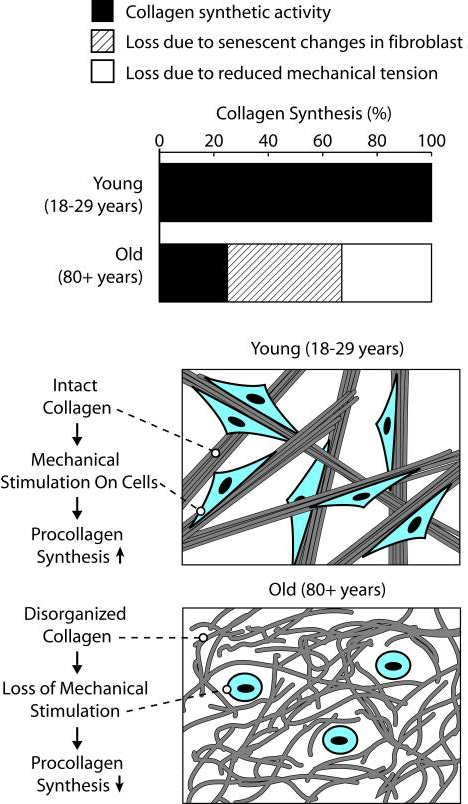
But sometime around your forties, your body started making less.
Not dramatically. Not overnight. Just... a little less each year. About one percent less, year after year, according to research published in the British Journal of Dermatology. A slow, invisible deficit that compounds the way a small leak eventually empties a pool.
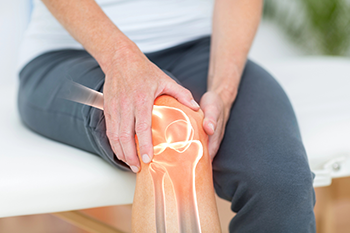
By the time you’re sixty, you’ve lost roughly twenty to twenty-five percent of this critical protein. The cushion has thinned. Bone is closer to bone. And those “morning calculations” I described earlier? That’s not aging. That’s your body running out of the raw material it needs to keep your joints working.
Research published in Obstetrics and Gynecology found that in the first five years after menopause, the body loses approximately thirty percent of this protein. The rate doubles. The timeline accelerates. And nobody warns you.
The protein is called collagen.
You’ve probably heard the word, maybe in a skincare commercial. But collagen isn’t a beauty ingredient. It’s the structural scaffolding of your entire body. It’s what your cartilage is made of. It’s what keeps your joints cushioned, your tendons flexible, your bones strong.
And your body is running out of it.
Not because you did something wrong. Not because you didn’t exercise enough or eat the right foods. Because this is what human biology does after forty — it slows down production of the one thing your joints need most, and nobody tells you it can be addressed.
That’s the part that made me angry when I first learned it. Not that it was happening. That nobody mentioned it.
Let me guess your current pain strategy.
You take ibuprofen. Maybe naproxen. Maybe you alternate. Some days you take two, some days four. On bad days, more. You figure it’s fine because it’s over the counter. If it were dangerous, they wouldn’t sell it at the grocery store, right?
Here’s what the research actually says.
A 2024 study published in Nature — one of the most respected scientific journals in the world — found that long-term NSAID use may actually worsen the osteoarthritis it’s supposed to help manage.
Read that again. The thing your doctor told you to take for joint pain is accelerating the cartilage damage underneath.
And that’s just the beginning.
These aren’t fringe findings from obscure journals. This is peer-reviewed, replicated medical research that your doctor may or may not have mentioned when they said “just take some Advil.”
So here’s the situation you’re actually in:
Your body stopped making enough collagen to keep your joints cushioned. The pain you feel is the result of that deficit. And the most common thing people take for that pain — over-the-counter anti-inflammatories — is masking the symptom while accelerating the underlying damage.
You’re not managing the problem. You’re wallpapering over a crack in the foundation while the crack gets wider every day.
Now, some people have already figured out the collagen piece. They’ve heard about it, bought a supplement, tried it for a few months. And for a lot of them... nothing changed. Their joints still hurt. They still did the morning math.
If that’s you, or if you know someone with that story, here’s what probably happened.
There are multiple types of collagen in your body. The most common supplements on the market — the big brands you see at the store, the ones with celebrity endorsements and pastel packaging — contain Type I collagen. Some include Type III.
Type I is real collagen. It does real things. It supports your skin, your hair, your nails, your bones.
Your articular cartilage — the cushion between your bones, the stuff that’s been wearing away since your forties — is eighty-five to ninety percent Type II collagen.
Type II. Not Type I.
This is like putting diesel in a gasoline engine and wondering why the car won’t start. The fuel is real. It’s just the wrong kind.
And here’s the part that should make your blood boil. The brands know this. Vital Proteins? Type I only. Sports Research? Type I and III. NeoCell, Live Conscious, Garden of Life — same story. They sell Type I because it comes from bovine hide. It’s cheap to source, cheap to process, and it lets them slap “collagen” on the label and charge forty dollars.
Type II collagen is a different story entirely. It comes from chicken sternum cartilage. It requires cold processing to preserve its molecular structure. It costs roughly three times more to produce.
They’re not stupid. They’re cheap. And they’re counting on you not knowing the difference.
| Brand | Collagen Type | Joint Cartilage? |
|---|---|---|
| Vital Proteins | Type I only | No |
| Sports Research | Type I & III | No |
| NeoCell | Type I & III | No |
| Garden of Life | Type I & III | No |
| Flex Force 5x | Types I, II, III, V, X | Yes |
A company called Fixity Health, out of Orlando, Florida, has been around since 2006. Their founder, Mark Edwards, built Flex Force 5x to solve exactly this problem: give people the collagen their joints actually need, not just the collagen that’s cheap to bottle.
Here’s what’s in it:
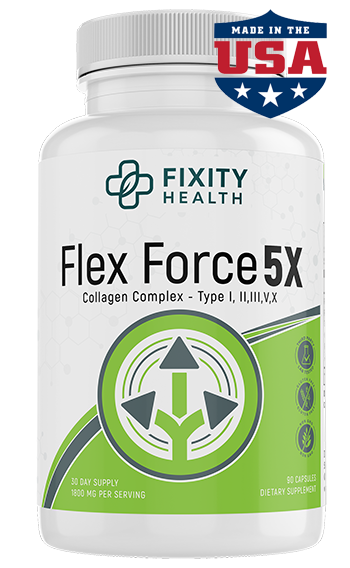
Type II is undenatured UC-II sourced from chicken sternum and cold-processed to preserve its triple-helix molecular structure. That structure matters. Heat-processed collagen loses the architecture that makes it effective. Cold processing keeps it intact.
The formula also includes glucosamine, chondroitin, and hyaluronic acid — three compounds with their own research base for joint support.
Total daily dosage: 1,800 milligrams. Ninety capsules per bottle. Thirty-day supply.
Made in the U.S. in an FDA-registered, GMP-certified facility. Non-GMO. Gluten-free.
This isn’t a kitchen-table supplement with a nice label. It’s a formulated product designed specifically for the problem you’re living with.
I’m not going to tell you this works because I say so. I’m going to show you what the clinical research shows, and then I’m going to tell you what those numbers actually mean for your Tuesday morning.
Collagen production restored in eight weeks.
A double-blind, placebo-controlled study at the University of Kiel, Germany — 114 women, 8 weeks, published in Skin Pharmacology and Physiology — found a sixty-five percent increase in procollagen Type I production.
That number is worth sitting with for a moment. Their bodies didn’t just use the supplemental collagen. They started making more of their own. Sixty-five percent more. As if the machinery had been sitting idle — not broken, just starving for raw materials — and the moment it finally got what it needed, it remembered exactly what to do. Your body wants to rebuild. It’s been waiting for you to give it something to rebuild with.
Nearly fifty percent reduction in wrinkle volume.
Same study. An average 49.9 percent decrease in eye wrinkle volume after eight weeks. Now, you’re not taking this for wrinkles. But here’s why this matters to your knees: wrinkles and joint deterioration share the exact same root cause — collagen loss. When the skin bounces back, it means the structural protein is being replenished throughout the body. What you can see in the mirror is a signal of what’s happening in the places you can’t see. Your cartilage doesn’t have a mirror. Your skin does.
Measurable skin elasticity improvement.
A 2024 randomized, double-blind, placebo-controlled trial of 130 participants, published in Dermatology Research and Practice, found a 22.7 percent improvement in skin elasticity after twelve weeks. Same study found a 31.9 percent improvement in clinical hair grading scores. These are the changes her friends started commenting on. These are the changes that made people look at her differently. Not because she was trying to look younger — because her body finally had the building material to hold itself together again.
Forty-two percent reduction in nail breakage.
Published in the Journal of Cosmetic Dermatology. Twenty-five participants, twenty-four weeks, 2.5 grams per day. Sixty-four percent achieved overall global clinical improvement. Your nails are collagen. Your hair is collagen. Your skin is collagen. And your cartilage is collagen. When the building material comes back, it comes back everywhere — in the tissues you can see and the ones you can only feel.
Every one of these studies is double-blind, placebo-controlled, and published in a peer-reviewed journal. This is not marketing language from a supplement label. This is what happened when researchers who had nothing to sell tested what happens when you give the body back the protein it makes less and less of.
The research is clear. Your body needs this.
Try it risk-free for 60 days.
This is a pattern we hear again and again. People start taking it for their joints. Then their spouse says something about their skin. Then their hairdresser comments on their hair. The collagen doesn’t know it’s “supposed to” only help joints — it goes where the body needs it.
Ready to feel the difference?
Choose your option below. 60-day guarantee on both.
You have three paths in front of you. I want to lay them out plainly because you deserve honesty, not a pitch.
Ibuprofen. Morning math. Smaller world. More things you “don’t feel like” doing. More invitations you turn down. The gradual, quiet loss of the life you still want to be living. Your collagen continues to decline at roughly one percent per year. The cushion gets thinner. The pain gets louder. The options get fewer.
And at some point down this path, a doctor sits you down and says “We should talk about surgery.”
Maybe it helps your skin and nails. It won’t address your cartilage because it’s the wrong type. You’ll spend three months taking it faithfully, feel no difference in your joints, and conclude “collagen doesn’t work for me.” It’s not that collagen doesn’t work. It’s that Type I collagen doesn’t rebuild Type II cartilage. Wrong fuel. Wrong engine.
Five types of collagen — including the Type II your cartilage is made of — in the right form, at the right dose, made by a company that’s been doing this since 2006. Start giving your body the raw material it ran out of, and keep giving it — because this isn’t a one-time fix. Your body doesn’t stop needing collagen after the first bottle. It needs it the way it needs water. Continuously.
You have two options. Same product. Same quality. Same 60-day guarantee. The only question is how you want to take care of yourself going forward.
The clinical research shows results over eight to twelve weeks — not two weeks, not one bottle. Collagen rebuilds gradually, and the supply needs to keep coming. One bottle gives you a start. Monthly delivery gives you the full clinical window and keeps going.
If you want to cancel after the first month — or the third, or the sixth — you cancel. One click. Done. No one will call you. No one will make it difficult. You’re not locked into anything except a better price.

Here’s the deal. You have sixty days.
Whether you choose monthly delivery or a single bottle — you’re covered. Same guarantee either way.
Take it every day. Pay attention. Notice whether the morning math changes. Notice whether the stairs get easier. Notice whether you stop thinking about your knees before you stand up.
If after sixty days you don’t feel a meaningful difference — or even if you just decide it’s not for you — you get a full refund. No restocking fees. No hassle.
And if you’re on the monthly delivery, you have two layers of protection. You can cancel the delivery anytime with one click — that’s layer one. And within the first 60 days, if you want your money back, you get it. That’s layer two. Cancel AND refund. Both available. No questions.
Most collagen brands give you thirty days and charge a fee to return the product. Fixity Health gives you ninety and eats the cost if it doesn’t work for you.
I can promise this because the people who try it don’t come back for refunds. They come back for refills.
In one version, you close this page. The morning math continues. The ibuprofen bottle stays on the nightstand. The world stays the size it is right now — and next month it’s a little smaller. The walk you’ve been thinking about taking stays a thought. The trip stays unbookable. Your daughter asks how you’re doing and you say “fine” and she knows you’re lying and you both pretend she doesn’t.
A year from now, you’re still adjusting. Still compensating. Still pretending it’s fine. And the doctor is starting to use the word “surgery” more often than you’d like.
That’s one version.
Here’s the other.
It’s a Tuesday morning, ten weeks from now. Your alarm goes off. You swing your legs over the side of the bed.
And you just... stand up.
No calculation. No bracing. No inventory of which joints are going to cooperate today and which ones aren’t. You stand up the way you used to, the way you’d forgotten you could, the way your body was designed to work before it ran out of the one protein that holds everything together.
You walk to the kitchen. You don’t hold the wall. You don’t pause at the doorway to let the stiffness work itself out. You just walk — the way walking is supposed to feel, when walking isn’t something you have to think about.
Your spouse is already up. They look at you and don’t say anything. But you catch it — that tiny shift in their expression. The absence of worry. The absence of that careful look they’ve been giving you for the last two years, the one that says I’m watching you slow down and I don’t know what to do about it. It’s gone. And in its place is something you haven’t seen in a while. Just... ease.
You pour your coffee. And then you do something you haven’t done in months. You step outside. Not to get the mail and come back. You keep going. Down the driveway. Past the mailbox. Down the block. And you’re walking — really walking, not the careful, measured, how-far-is-too-far version of walking, but the kind where your legs just go and your mind wanders and you forget, for entire minutes at a time, that you have knees at all.

Your daughter calls that afternoon. Asks if you want to come over Saturday, take the grandkids to the park. You say yes before she finishes the sentence. And Saturday comes, and your grandchild runs to you and says “get down here” and you get down on the grass and you play. You actually play. And when it’s time to get up, you get up. No reaching for the bench. No waiting for someone to offer a hand. No sound — you know the one, that involuntary groan that you’ve started making every time you stand, the one you pretend is just a habit but both of you know what it really means. That sound is gone. You just stand up. And your grandchild is already running to the next thing and you’re right behind them.

That night, you’re sitting on the couch and it hits you. You didn’t do the math this morning. You don’t know when you stopped. But you stopped.
And in the bathroom, on the counter, there’s a bottle that showed up last week without you having to think about it. Because you chose the monthly delivery. Because you decided two months ago that this wasn’t something you wanted to remember to reorder — it was something you wanted to just have. The way you have toothpaste. The way you have coffee. The things that just show up because they’re part of your life now.
This is not a fantasy. Linda was told she needed knee replacement surgery. She proved her doctor wrong. Petru went from unable to climb stairs to playing competitive table tennis. Margaret’s joint pain is “virtually gone” and her hair is thicker than it’s been in years.
Their bodies were running on empty too. They gave them back what was missing. Not once. Continuously.
And maybe — maybe — you wake up one Tuesday and realize you forgot to do the math.
You’ll see two buttons. If you’re ready to do this right — monthly delivery, $39, free shipping, cancel anytime — click the first one. If you want to start with a single bottle at $49, that’s there too.
Either way, you’ll go to a secure checkout page. Enter your information — takes thirty seconds. Your order ships right away.
P.S. You’re covered by a full 60-day money-back guarantee — whether you choose monthly delivery or a single bottle. Take Flex Force 5x for three months. If you don’t feel a real difference in your mornings, your joints, or your life, you get a complete refund. No hoops. No fees. And if you’re on monthly delivery, you can cancel anytime with one click — no phone call required. Linda’s doctor told her she needed surgery. She proved him wrong. Give your body the same chance.
P.P.S. If you’re a woman who’s been through menopause, this matters even more. The research shows roughly 30% collagen loss in just the first five years post-menopause. That’s not gradual decline — that’s a cliff. Every month you wait, the deficit compounds. Monthly delivery at $39 with free shipping means your body never goes a single month without what it needs. No gaps. No reordering. No running out at the worst possible time.
That stopped me cold the first time I read it. Her doctor said knee replacement in six months. A surgery that costs twenty thousand to forty-nine thousand dollars. Six months of recovery. And she proved him wrong with a daily supplement that costs less than a dollar a day. Four words — “I proved him wrong” — that carry more weight than any clinical number.